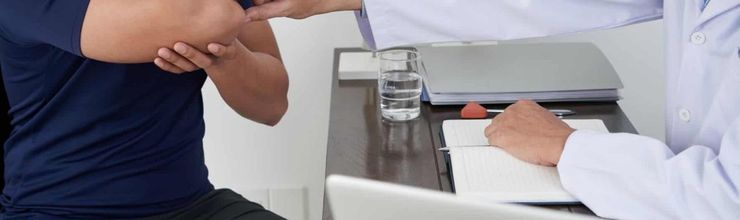
You woke up with an elbow that felt like someone had smashed it with a bat while you slept. It is swollen, hot, and straightening or bending your arm is off the table. Maybe there is a squishy lump right over the pointy bone. You did not fall, you did not bang it, and now you are wondering if you could have slept wrong this badly. Probably not. It might be gout, and gout in the elbow behaves differently from the big-toe attack everyone has heard about.
The elbow shows up on gout’s list of targets far more often than most people expect, and it brings its own problems: a superficial bursa that balloons into a visible lump, a real chance of infection that looks almost identical from the outside, and lumps that can sit there for years when the underlying urate level is never treated. Here is how to read the signs, what actually calms an attack down, and when someone needs to draw fluid out of that elbow instead of just handing you pills.
What Does Gout in the Elbow Actually Feel Like?
The pattern matters more than any single symptom. A gout flare starts fast, often overnight, and usually peaks within 24 hours. You go to bed fine and wake up holding an arm you barely recognize.
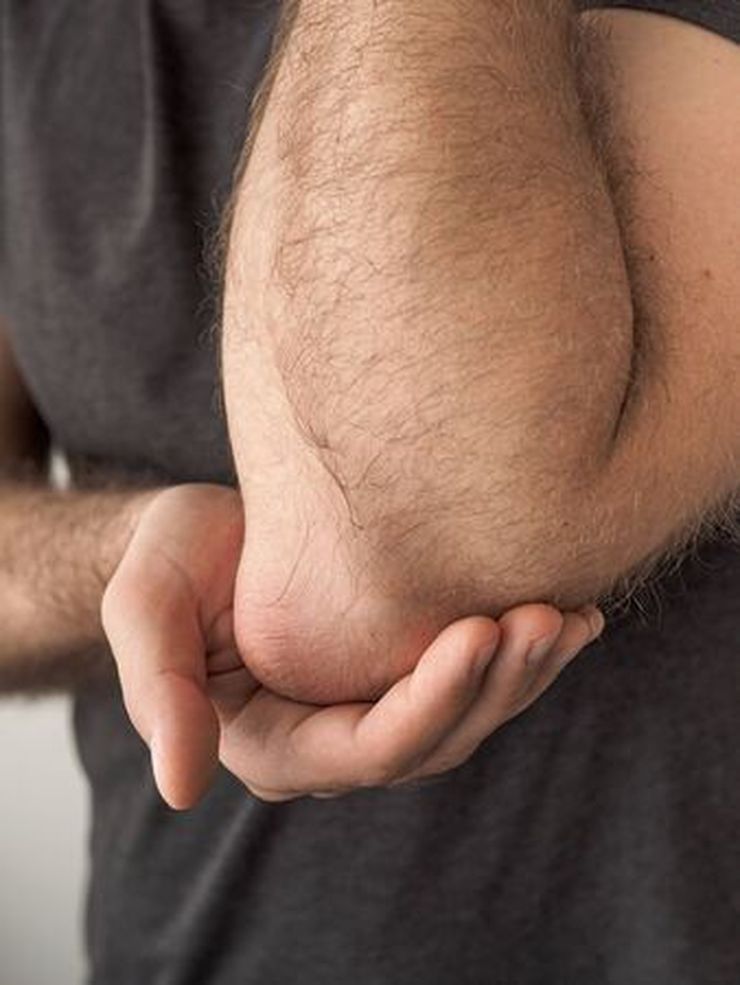
- The point of the elbow puffs up. Most elbow flares involve the back of the elbow, where a small fluid-filled cushion called the olecranon bursa sits under the skin. When it inflames, it swells into a soft, dome-shaped lump over the bone.
- It runs hot and red. Touch the back of your elbow with the back of your fingers and compare it with the other one. A gouty elbow often feels noticeably warm, and the skin can turn pink or red.
- Movement hurts, both ways. Bending and straightening squeeze the swollen tissues, so people hold the arm somewhere in the middle, the one position that buys the most room.
- The pain is severe and throbbing. People describe it as crushing, pulsating, or “like a hammer on the bone.” Some can’t even tolerate a sleeve brushing over it.
Gout affects about 3.9% of US adults, roughly 9.2 million people, and the elbow is affected in about 20% to 30% of people with the condition, a figure from a 2023 review of elbow pain. That number surprises readers who only know the toe version. Early gout favors the lower body, but as years and urate crystals pile up, the elbows, fingers, wrists, and bursae start getting attacked too (here is how it presents in the fingers and hands).
Is That Lump Gouty Bursitis or Just Plain Bursitis?
This question decides everything about what happens next. The lump on the back of your elbow is the olecranon bursa, a thin sac with a few drops of lubricating fluid in it. Lean on hard surfaces for years, land on the elbow, or irritate it repeatedly, and the bursa fills with extra plain fluid. That is plain olecranon bursitis, sometimes called student’s elbow. The lump can be the size of a golf ball, but it usually does not hurt much, does not feel hot, and the skin stays normal color.
Gout does something else. When urate crystals spill into the bursa, the immune system reacts to them and the whole sac becomes inflamed: painful, red, hot, and tender. The same thing happens when calcium pyrophosphate crystals show up, the chemistry behind pseudogout. You cannot tell plain fluid, gouty fluid, and pseudogout fluid apart with your eyes. It takes a needle, a slide, and a microscope, where urate crystals look needle-shaped and shine one specific color under polarized light, the test that anchors the 2015 American College of Rheumatology and EULAR classification rules for diagnosing gout. In the long run, untreated urate deposits can also harden into tophi, firm chalky lumps fixed around the elbow that can even drain white toothpaste-like material through the skin.
Could It Be Infected? This Is the One Not to Guess On
The olecranon bursa sits right under thin skin over a bony point, which makes it unusually easy for bacteria to get in, often after a cut, scrape, or even just cracked skin from leaning. Septic bursitis and crystal bursitis can look nearly identical: a red, hot, swollen lump over the elbow, pain, and sometimes a fever. And here is the uncomfortable part the internet skips: crystals and infection can share the same bursa. Finding urate crystals does not prove the elbow is not infected.
Take it seriously if the redness is spreading beyond the elbow, red streaks are tracking up your arm, you have pus or an open wound, fever or chills show up, or you feel ill all over. People with diabetes or weakened immune systems should move even faster. Anyone facing those signs belongs in urgent care or an emergency department the same day, not at home testing another pill. We walked through the fever-versus-infection question in detail here: Can gout itself cause a fever, and when is it an infected joint?
The fix at the clinic is quick. A clinician cleans the skin, draws bursal fluid with a needle, and sends part of it under a microscope for crystals and part to the lab for a bacterial culture. That one aspiration answers the questions no amount of internet research can. A systematic review covering 1,278 people with olecranon bursitis found nonsurgical care works better and causes fewer complications than surgery, which is why drainage, antibiotics when needed, and medication are the standard first moves.
What Actually Settles an Elbow Flare Down?
Three treatments form the backbone of an acute flare, and all of them work better started early, ideally within the first 24 hours.
Nonsteroidal anti-inflammatory drugs (NSAIDs). Naproxen (Naprosyn, Aleve), diclofenac (Voltaren), and indomethacin (Indocin) are common picks at a full dose for several days. Kidney disease, stomach ulcers, heart failure, and some blood thinners can rule them out, which is one reason an elbow flare drives people to the doctor.
Colchicine. The current dose is low, not the old pile-of-pills routine. In the AGREE trial of 184 people, a low dose of 1.2 mg followed by 0.6 mg an hour later gave roughly the same early relief as the old high-dose regimen with far less stomach trouble. About 38% of people on the low dose reported at least 50% pain relief by 24 hours, compared with about 16% on placebo. Diarrhea hit 23% on the low dose and nobody vomited; with the high dose, 77% got diarrhea and 17% vomited. Same benefit, a fraction of the misery. It works best when taken within 24 hours of flare onset.
Corticosteroids. A clinician can drain the inflamed bursa and inject a steroid straight into it, which often calms a single swollen elbow quickly while sparing the rest of your body a course of oral steroids. Oral prednisone (sold under names such as Rayos) is the alternative and works about as well as NSAIDs when the whole-body route is needed.
Add the boring measures that genuinely help: rest the arm instead of lifting or gripping, ice the elbow for 15 to 20 minutes at a time with a towel between the ice and skin, and keep it elevated when you can. Ice has real evidence behind it: in a small randomized study of 19 people, the ice group’s pain fell by 7.75 cm on a 10 cm scale, versus 4.42 cm in the control group. Skip the hot shower aimed straight at the elbow; heat opens up blood flow and tends to feed the swelling. Why? The short version is here: Ice or heat for a gout flare?
If you already take allopurinol (Zyloprim), febuxostat (Uloric), or another urate-lowering drug, keep taking it through the flare. Stopping and restarting swings your urate level and can lengthen or re-trigger attacks. Starting a new urate drug mid-flare is a separate conversation, usually held once the acute episode is settling, with protective anti-inflammatory medication for the first months. That timing is explained here: Why a urate drug can itself trigger a flare.
How Long Does Elbow Gout Last?
An untreated flare commonly runs about a week to 10 days, and the swelling can linger a few extra days even after the pain fades. Treated early, most people feel substantially better within 24 to 48 hours and are close to normal inside a week.
If the elbow stays swollen and angry after a week of proper treatment, keeps filling back up after it is drained, or relapses within days, something is off. The list includes infection, a different crystal, or a bursa that simply keeps producing fluid and needs a different approach. Go back in rather than cycling through pills on your own.
When Elbow Gout Keeps Coming Back
Recurrent elbow flares, tophi around the joint, kidney stones, or kidney disease are signs the problem is no longer an occasional attack. Gout comes from urate crystals, and crystals keep forming while urate in the blood stays above its saturation point, about 6.8 mg/dL. The fix is long-term urate-lowering treatment aimed at a serum urate below 6 mg/dL, and below 5 mg/dL when tophi or severe disease is present. Hold the target long enough and the existing deposits, including tophi, dissolve over time. That is how people go from flares every month to years without one.
A normal urate reading during an attack does not rule gout out, by the way. The number can dip temporarily while a flare is active, so diagnosis may rest on the bursal fluid, imaging such as ultrasound or dual-energy CT, or a repeat blood test after things settle. The details are here: Why your urate can look normal during a flare. And when gout starts showing up in several joints at once, it usually means the urate burden has been silently building for years, which we covered here: Why gout spreads from one joint to several.
Frequently Asked Questions
Can gout make the back of my elbow swell up without any injury?
Yes, and that pattern is a clue. A hot, red, painful lump appearing overnight over the point of the elbow fits crystal bursitis well. A soft lump that grows slowly after weeks of leaning on the elbow, without heat or much pain, points more toward plain olecranon bursitis.
Do I need the fluid drained, or will pills be enough?
Many flares settle with medication alone. Aspiration becomes important when infection needs ruling out, when the bursa is hugely swollen and tense, or when a steroid injection is the chosen route. Draining it can also give instant relief just by releasing pressure, and the fluid confirms which kind of bursitis you actually have.
Is gout in the elbow more serious than gout in the toe?
The disease is the same, but the elbow raises different concerns. The bursa is close to the skin, so infection is commoner and harder to rule out by symptoms alone, and chronic urate deposits there can turn into visible tophi. The good news is the bursa is easy to examine, drain, and inject.
Can I keep lifting weights or doing push-ups during a flare?
Not while it is acute. Rest, ice, and early medication are the moves, and pressing the elbow directly into a bench or floor adds mechanical irritation on top of the crystal inflammation. Return to training gradually once the heat, swelling, and pain are genuinely gone.
Will diet alone get rid of elbow gout?
Diet helps but usually does not fix gout on its own. The ACR guideline notes diet alone rarely lowers serum urate far enough to hit the treatment target, which is why medication carries the load for recurrent gout. Eating and drinking less of the things that raise urate still matters for flares and your overall health.
References
- Chen-Xu M, Yokose C, Rai SK, Pillinger MH, Choi HK. Contemporary Prevalence of Gout and Hyperuricemia in the United States and Decadal Trends: The National Health and Nutrition Examination Survey, 2007-2016. Arthritis Rheumatol. 2019;71(6):991-999. doi:10.1002/art.40807. PMID: 30618180
- Chung HJ, Joo YB, Park JY, Lee WY. Differential Diagnosis of Elbow Pain. Ewha Med J. 2023;46(4):e13. doi:10.12771/emj.2023.e13. PMID: 40703946
- FitzGerald JD, Dalbeth N, Mikuls T, et al. 2020 American College of Rheumatology Guideline for the Management of Gout. Arthritis Care Res (Hoboken). 2020;72(6):744-760. doi:10.1002/acr.24180. PMID: 32391934
- Terkeltaub RA, Furst DE, Bennett K, Kook KA, Crockett RS, Davis MW. High versus low dosing of oral colchicine for early acute gout flare: twenty-four-hour outcome of the first multicenter, randomized, double-blind, placebo-controlled, parallel-group, dose-comparison colchicine study. Arthritis Rheum. 2010;62(4):1060-1068. doi:10.1002/art.27327. PMID: 20131255
- Schlesinger N, Detry MA, Holland BK, et al. Local ice therapy during bouts of acute gouty arthritis. J Rheumatol. 2002;29(2):331-334. PMID: 11838852
- Sayegh ET, Strauch RJ. Treatment of olecranon bursitis: a systematic review. Arch Orthop Trauma Surg. 2014;134(11):1517-1536. doi:10.1007/s00402-014-2088-3. PMID: 25234151
- Neogi T, Jansen TLTA, Dalbeth N, et al. 2015 Gout Classification Criteria: an American College of Rheumatology/European League Against Rheumatism collaborative initiative. Arthritis Rheumatol. 2015;67(10):2557-2568. doi:10.1002/art.39254. PMID: 26352873
- Dalbeth N, Choi HK, Joosten LAB, et al. Gout. Nat Rev Dis Primers. 2019;5(1):69. doi:10.1038/s41572-019-0115-y. PMID: 31558729
Reviewed by the GoutSavvy Editorial Team