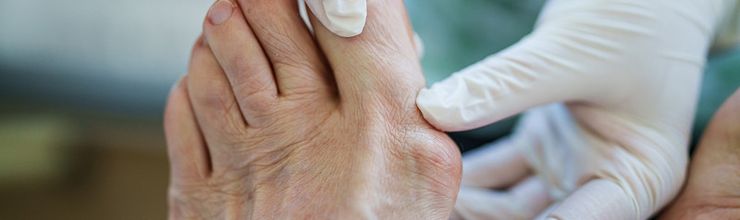
You woke up at 3 a.m., and your big toe has staged a full protest. It’s swollen. It’s red. Even the bedsheet feels like a weapon. Is this a gout attack, or has that bump you’ve been ignoring for years finally turned nasty?
Here’s the short version: if the pain went from nothing to “call an ambulance” in a matter of hours, it’s almost certainly gout. If you’ve had a slow-growing bump and a toe that’s been drifting sideways for months or years, that’s a bunion. The two can even share the same joint, which is where things get confusing.
Let’s walk through how to tell them apart, what to do for each, and when it’s time to stop guessing.
What exactly is happening in each condition?
Gout is an arthritis caused by needle-like uric acid crystals forming inside a joint. Your immune system notices them and responds the way it responds to an infection: swelling, heat, redness, and pain that is wildly out of proportion to anything that touched the joint. Gout has a famous favorite spot, the first metatarsophalangeal joint, which is the big knuckle where your big toe meets your foot. An attack there is called podagra, and the first MTP joint is the most common site of a first attack.
Why that joint? It’s the coolest joint in the body, it takes a beating with every step, and uric acid crystals form more easily in cooler tissue and in cartilage already worn down by osteoarthritis. Edward Roddy laid all of this out in a review of why gout targets the foot: lower temperature, minor physical shock, and an osteoarthritis-prone joint make it the perfect storm.
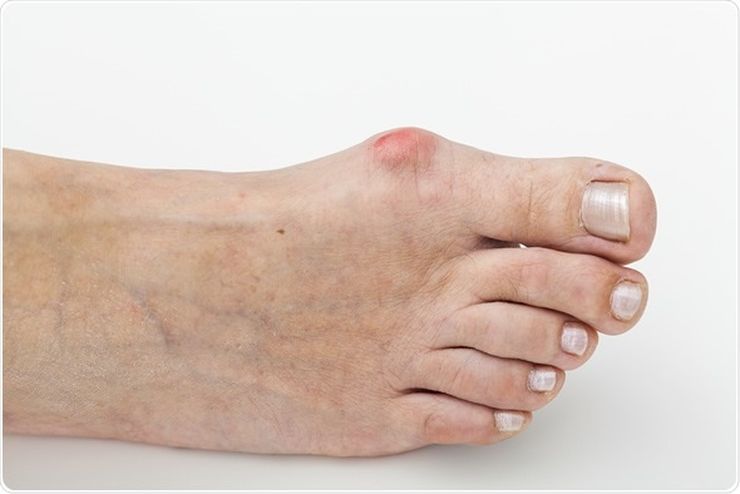
A bunion is a different animal entirely. Its medical name is hallux valgus, and it’s a structural problem. The first metatarsal bone drifts inward toward the other foot while the big toe leans outward toward the smaller toes. The head of that bone then sticks out on the inside of your foot, creating the familiar bump. It develops gradually, often over years, driven by genetics, flat or unstable feet, and footwear that crowds the toes. Narrow, high-heeled shoes don’t help, though the deformity usually runs in families even before the shoes show up.
The six differences that matter most
1. How fast it starts. This is the single best clue. A gout flare typically peaks within 12 to 24 hours, often waking people from sleep. A bunion grows so slowly that most people can’t pinpoint when it began. If your joint looked normal yesterday and looks like a golf ball today, gout is the answer.
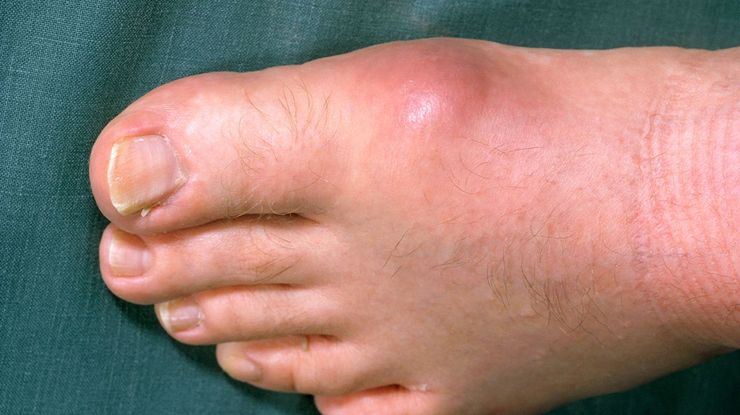
2. What it looks like. Gout produces redness and swelling that can swallow the whole joint, with shiny, tight skin that feels hot to the touch. A bunion is a firm bump on the inside edge of the foot, with the big toe visibly angled toward the second toe. The skin over it may be red after a day in tight shoes, but it usually calms down.
3. How the pain behaves. Gout pain is severe and constant for days, then eases and eventually disappears, even if you do nothing. Bunion pain is usually a duller ache, worse at the end of the day, after standing for hours, or in certain shoes, and it does not fully go away because the deformity is still there.
4. Who tends to get it. Gout is common, affecting about 3.9% of U.S. adults, roughly 9.2 million people, and it hits men more often and earlier in life: 5.2% of men versus 2.7% of women, according to national survey data from 2015 to 2016. Bunions tilt the other way. A global review of 45 studies estimated hallux valgus in about 23.74% of females but just 11.43% of males, and the deformity becomes more common with age.
5. What sets it off. A gout flare often follows a recognizable trigger: beer, a heavy seafood or steak dinner, dehydration, illness, surgery, or a crash diet. Bunion symptoms track mechanical pressure instead: narrow toe boxes, long shifts on your feet, or a long run.
6. Whether it moves or comes back elsewhere. Untreated gout tends to return, and later attacks can show up in the ankle, knee, elbow, or other joints. A bunion stays put and slowly gets worse in the same spot. If your “bunion” suddenly appeared after a weekend of beer and BBQ, take a closer look.
Can you have both? Yes, and it’s not rare
Here’s the twist. The same joint can house a bunion and a gout flare at the same time. Someone with a long-standing bunion develops high uric acid, crystals deposit in that already damaged joint, and suddenly the old familiar bump is red, hot, and screaming. Roddy’s review notes that crystals deposit more readily in osteoarthritic cartilage, and bunions often come with wear-and-tear arthritis of the first MTP joint.
So a bunion does not rule gout out. In fact, a joint that has been structurally abnormal for years may be more hospitable to crystals than a healthy one.
How doctors actually confirm the diagnosis
The gold standard for gout is simple and old-fashioned: a doctor draws a small amount of fluid from the swollen joint and looks at it under a special microscope. Monosodium urate crystals are needle-shaped, and light helps identify them. Find them, and the question is settled, no scoring required.
When joint fluid can’t be obtained, rheumatologists use the 2015 American College of Rheumatology and European League Against Rheumatism classification criteria, which weigh the joint involved, the pattern of attacks, the uric acid level, and imaging findings. Those criteria performed well in testing, with about 92% sensitivity and 89% specificity. Imaging now helps too. An ultrasound can show a “double contour” line of crystals coating the cartilage, and dual-energy CT can color-code urate deposits around the joint.
One warning about blood tests: a normal uric acid reading during an attack does not prove your pain isn’t gout. Levels often drop during a flare. If the picture looks like gout but the number looks fine, most doctors repeat the test after the attack settles.
A bunion, by contrast, is diagnosed mostly by looking and by a standing X-ray that measures how far the bones have drifted. No microscope or uric acid test is required.
Treatment: gout attacks the chemistry, bunions attack the mechanics
Treating a gout flare means calming the fire fast. The American College of Rheumatology’s 2020 guideline supports three options: colchicine, nonsteroidal anti-inflammatory drugs, or glucocorticoids, started as early as possible. Which one fits depends on your kidneys, your stomach, and the other medicines you take, so check with a clinician rather than raiding a friend’s pill bottle. If flares keep coming back, the bigger fix is urate-lowering therapy, usually allopurinol first, with the dose adjusted until uric acid stays below 6 mg/dl. Lower the uric acid, and the crystals slowly dissolve.
If the medicine you tried did nothing, timing may be the problem. Gout medicines work far better when started in the first hours rather than the third day.
A bunion needs pressure relief, not anti-inflammatory chemistry. Roomier shoes with a wide, deep toe box, a cushioned bunion sleeve or shield, and ice at the end of a sore day handle most mild cases. A review of conservative forefoot care describes toe spreaders, bunion shields, and valgus splints as the standard non-surgical tools, along with simply avoiding tight or high-heeled shoes. These measures ease symptoms but do not straighten the bone. Only surgery realigns the joint, and it’s generally reserved for pain that persists despite good footwear, not for cosmetic concerns.
When to get seen instead of self-diagnosing
Some situations don’t belong in a wait-and-see bucket. Get prompt medical attention if the pain is unbearable and you have fever or chills, because a bacterial joint infection can mimic gout and can damage a joint in days. Seek care if this is your first possible gout attack, since confirming it changes the long-term plan, or if swelling follows an injury and you might have a fracture. Recurrent attacks, visible lumps elsewhere, or kidney stones also deserve a proper workup rather than repeated self-treatment.
And if the bump has slowly worsened over years and daily shoes no longer fit, a podiatrist or orthopedic foot specialist can map out options without anyone rushing you to surgery.
Frequently asked questions
Can a bunion turn into gout?
No. A bunion is a bone alignment problem and gout is a crystal problem, so one cannot transform into the other. But gout can develop in a joint that already has a bunion, and a flare on top of a bunion is easy to mistake for the bunion simply worsening.
Can gout make my toe look crooked like a bunion?
Over many years, untreated gout can leave firm lumps called tophi around the joint, and these can change its shape. During an attack, swelling can also make the toe sit oddly. But the sideways drift that defines a bunion develops slowly and stays visible even when there is no flare.
Will a uric acid test tell me which one I have?
It helps, but it is not decisive on its own. High uric acid supports gout, yet many people with high levels never flare, and levels can be normal during an attack. The most reliable proof is crystals found in joint fluid, plus the pattern of symptoms and sometimes ultrasound or dual-energy CT.
If I have a bunion, do I need surgery?
Most people don’t. Wide shoes, padding, ice, and activity changes control symptoms for the majority. Surgery is considered when pain keeps interfering with daily life despite those measures, rather than because of how the foot looks.
Can gout and bunion pain be prevented at the same time?
Yes, and the habits barely conflict. Roomier shoes reduce bunion pressure, while staying hydrated, limiting alcohol and sugary drinks, and keeping follow-up appointments for urate-lowering treatment reduce gout flares. If you take allopurinol, keep taking it through an attack unless your doctor says otherwise.
References
- Chen-Xu M, Yokose C, Rai SK, Pillinger MH, Choi HK. “Contemporary Prevalence of Gout and Hyperuricemia in the United States and Decadal Trends: The National Health and Nutrition Examination Survey, 2007–2016.” Arthritis & Rheumatology. 2019;71(6):991–999. doi:10.1002/art.40807. PMID: 30618180.
- Roddy E. “Revisiting the pathogenesis of podagra: why does gout target the foot?” Journal of Foot and Ankle Research. 2011;4:13. doi:10.1186/1757-1146-4-13. PMID: 21569453.
- Cai Y, Song Y, He M, He W, Zhong X, Wen H, Wei Q. “Global prevalence and incidence of hallux valgus: a systematic review and meta-analysis.” Journal of Foot and Ankle Research. 2023;16(1):63. doi:10.1186/s13047-023-00661-9. PMID: 37726760.
- FitzGerald JD, Dalbeth N, Mikuls T, et al. “2020 American College of Rheumatology Guideline for the Management of Gout.” Arthritis Care & Research. 2020;72(6):744–760. doi:10.1002/acr.24180. PMID: 32391934.
- Neogi T, Jansen TL, Dalbeth N, et al. “2015 Gout Classification Criteria: an American College of Rheumatology/European League Against Rheumatism collaborative initiative.” Arthritis & Rheumatology. 2015;67(10):2557–2568. doi:10.1002/art.39254. PMID: 26352873.
- Park CH, Chang MC. “Forefoot disorders and conservative treatment.” Yeungnam University Journal of Medicine. 2019;36(2):92–98. doi:10.12701/yujm.2019.00185. PMID: 31620619.
- Richette P, Doherty M, Pascual E, et al. “2018 updated European League Against Rheumatism evidence-based recommendations for the diagnosis of gout.” Annals of the Rheumatic Diseases. 2020;79(1):31–38. doi:10.1136/annrheumdis-2019-215315. PMID: 31167758.
Reviewed by the GoutSavvy Editorial Team