
You wake up at 3 a.m. and your wrist feels like someone smashed it with a hammer. You didn’t fall. You didn’t lift anything heavy yesterday. It’s red, hot, swollen, and gripping a coffee mug is suddenly out of the question.
Sound familiar? Most people assume gout only attacks the big toe. It doesn’t. The same uric acid crystals that wreck your foot can land in your wrist, a knuckle, or a finger joint, and when they do, the flare is just as brutal.
Roughly 3.9% of adults in the United States, about 9.2 million people, have gout, according to national survey data from 2015 to 2016.[1] If your wrist or hand is on the receiving end, here is what is actually happening, how to tell it apart from other causes, and what to do about it.
Can You Really Get Gout in Your Wrist and Hand?
Yes. Gout is caused by needle-like crystals of monosodium urate that form when there is too much uric acid in your blood. These crystals can settle in almost any joint, tendon, or soft tissue, not just the one at the base of your big toe.
The first gout flare lands in the foot more often than anywhere else, which is why the condition has that big-toe reputation. But the hand and wrist are common sites as the disease goes on, especially in people who have had high uric acid for years without treatment. A review of gout in the hand and wrist calls it the most common inflammatory arthritis seen by upper-extremity surgeons.[2]
Other less obvious spots get their share too. We have covered what happens when gout lands in the elbow, the knee, and even the Achilles tendon at the back of the heel.
How rare is a wrist flare as the very first sign? The figure cited in the literature is 0.8% to 2% of all gout cases.[3] First flare, yes. Over a lifetime, the picture changes. People with untreated gout have been reported to have roughly a 19% to 30% chance of developing gout in the wrist at some point.[3]
What a Wrist or Finger Flare Feels Like
The pattern is the same as gout anywhere else, and it is hard to miss once you know it:
- It hits fast. Pain ramps up over a few hours, often overnight. You go to bed fine and wake up in serious trouble.
- The joint is hot, red, and swollen. The skin can look tight and shiny, and even a light touch hurts. For a wrist flare, the weight of a sheet or a sleeve is enough to make you flinch.
- Moving it is not an option. Gripping, twisting a doorknob, or rotating the wrist to check your phone can be agonizing.
- A finger flare can look like a jammed knuckle. One finger joint swells up while the rest of the hand looks normal, which is why people often assume an injury.
- You may feel generally off. A low fever or a washed-out feeling can come with a bad flare.
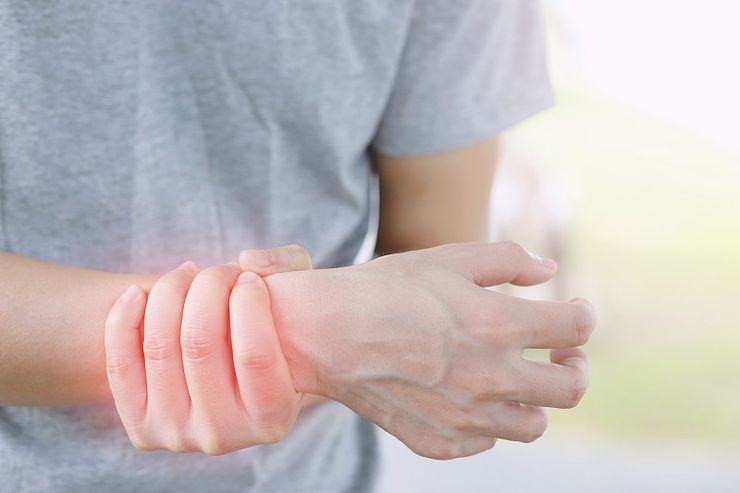
An untreated flare in the wrist or finger usually peaks in the first day or two and then slowly eases over a week or two if it is treated promptly.
Why Gout Ends Up in the Wrist
Uric acid has a quirk: monosodium urate is less soluble at lower temperatures. Lab measurements going back decades show the crystals form more readily the cooler the tissue gets.[4] That is a big part of why the big toe, far from your warm core, is the classic first target.
Your hands and wrists are cooler than the trunk of your body, and the small joints of the fingers are cooler still. Add in years of high uric acid, and crystals find their way in. Once they are there, they can sit quiet for a long time before something sets off a flare, like dehydration, a night of drinking, an illness, surgery, or a crash diet.
Serum urate above about 6.8 mg/dL is the level at which crystals can start to come out of solution, which is also why doctors treat to a target below 6 mg/dL rather than just aiming for the lab’s “normal” range.
How Doctors Tell It Is Gout and Not Something Else
This is the part worth slowing down for, because a hot, swollen wrist has a long list of impostors. A sprain, an infection, a rheumatoid arthritis flare, and pseudogout (calcium crystals rather than urate) can all look similar from the outside. The 2015 gout classification criteria, developed jointly by the American College of Rheumatology and the European League Against Rheumatism, treat crystals seen under a microscope as the gold standard.[5]
In practice, your doctor may use:
- Joint aspiration. A small sample of fluid drawn from the wrist or finger is checked for urate crystals. This is the most direct answer, and it also helps rule out a bacterial infection, which needs completely different treatment.
- Ultrasound. Gout deposits can show a bright “double contour” line over the joint cartilage. A 2026 review found musculoskeletal ultrasound useful for telling gouty arthritis apart from rheumatoid arthritis.[6] Ultrasound involves no radiation and can be done in the office.
- Dual-energy CT. This scan can map urate deposits directly and is especially helpful in confusing cases or when tophi are suspected.
- Your uric acid level. Useful, but don’t be fooled: a uric acid reading can be normal in the middle of a flare, so a single “normal” number does not rule gout out.
If you have fever, spreading redness, feel genuinely unwell, or the pain is escalating rather than settling, get checked the same day. An infected joint can destroy cartilage in hours and is not something to wait out at home.
Tophi, Trigger Finger, and Carpal Tunnel: When Gout Stays for Years
Long-standing deposits can do more than flare. Chalky lumps called tophi can show up over the knuckles, at the base of a finger, on the point of the elbow, or around the wrist. They are firm, sometimes visible under the skin, and they can slowly weaken your grip or make delicate tasks like buttoning a shirt difficult.
Crystals also get into tendons. Gouty infiltration of the flexor tendons at the wrist can cause a finger that catches or locks, or a contracture where the finger will not straighten. In one reported case, a 45-year-old man’s inability to extend a finger turned out to be the first ever sign of gout, with urate crystals packed into a flexor tendon and a serum uric acid of 8.6 mg/dL.[3]
A lump in the wrist can also press on the median nerve and cause carpal tunnel syndrome, with numbness and tingling in the thumb, index, and middle fingers. Surgeons have reported tophi growing inside tendons[7] and even under the lining of the median nerve itself.[8] If you have new numbness or weakness in the hand along with a lump, that warrants a prompt visit rather than home treatment.
Treating a Wrist or Hand Flare
For an acute flare, the playbook is the same three options the 2020 American College of Rheumatology guideline strongly recommends: colchicine, nonsteroidal anti-inflammatory drugs (NSAIDs), or glucocorticoids.[9] What matters is starting early, ideally within the first 24 hours, and picking the option that fits your kidneys, stomach, and other medications.
The colchicine evidence is worth knowing, because old-style high dosing causes a lot of unnecessary misery. In a randomized trial of 184 people with early flares, a low-dose regimen of 1.8 mg total produced at least a 50% pain reduction at 24 hours in 37.8% of people, compared with 15.5% on placebo, with side effects close to placebo.[10] The old high-dose schedule of 4.8 mg did not work any better and caused significantly more diarrhea and vomiting. If a bottle or an old handout tells you to keep popping pills until you get sick, that advice is out of date.
NSAIDs (such as ibuprofen or naproxen) work for many people but need caution if you have kidney disease, ulcers, take blood thinners, or are on certain heart medicines. If an over-the-counter NSAID did nothing for a past flare, this rundown on why ibuprofen sometimes fails explains what usually went wrong.

A glucocorticoid, often a short oral course or an injection into or near the joint, is a common choice when NSAIDs and colchicine are risky.
While the medicine kicks in, rest the joint, ice it for 15 to 20 minutes at a time with a cloth between the pack and your skin, and skip alcohol and heavy purine meals. Do not start or stop a daily urate-lowering pill on your own in the middle of a flare without talking to your doctor; if you already take allopurinol or febuxostat, keep taking it unless told otherwise.
Stopping the Next One Before It Reaches Your Hand
Flare treatment gets you through the week. Urate-lowering therapy is what keeps crystals from piling up in the next joint.
The 2020 guideline strongly recommends starting urate-lowering therapy for people with tophi, joint damage visible on imaging, or frequent flares, with allopurinol the preferred first-line choice, including for people with moderate to severe chronic kidney disease.[9] Dosing starts low, allopurinol at 100 mg a day or less (lower in kidney disease), and climbs until your uric acid stays under 6 mg/dL. When therapy starts, anti-inflammatory prophylaxis, often low-dose colchicine, is advised for at least 3 to 6 months, because dissolving crystals can briefly stir up a flare.
The lifestyle pieces support the medication rather than replace it: limit alcohol, especially beer; cut back on sugary drinks; stay hydrated; and keep portions of high-purine seafood and organ meats in check. Only about one-third of people with gout in the United States were on urate-lowering therapy in recent national data,[1] which helps explain why preventable tophi and hand damage still show up in surgeon’s offices.
Frequently Asked Questions
Can gout affect just one finger?
Yes. A flare can land in a single finger joint, often a knuckle, and leave the rest of the hand looking normal. Sudden overnight pain, heat, and swelling in one finger with no injury is a typical pattern, though an infection can look similar and needs checking if you are feverish or getting worse.
Why did gout show up in my wrist instead of my toe?
The wrist is a cooler joint, which favors crystal formation, and long-standing high uric acid tends to spread beyond the foot over time. Wrist gout as the very first flare is uncommon, cited at 0.8% to 2% of cases, while untreated people have a reported 19% to 30% lifetime chance of wrist involvement.
Will a wrist gout flare go away on its own?
Most flares ease over one to two weeks even without treatment, but waiting means more pain, lost sleep, and no check for an infected joint. Starting colchicine, an NSAID, or a glucocorticoid within the first 24 hours shortens the ordeal and is what the 2020 guideline recommends.
Can gout cause carpal tunnel syndrome?
It can. Tophi or thickened inflamed tendon tissue at the wrist can compress the median nerve, producing numbness and tingling in the thumb, index, and middle fingers. New nerve symptoms with a wrist lump should be evaluated promptly, sometimes with imaging or nerve testing.
If my uric acid is normal during the flare, is it still gout?
It can be. Serum uric acid often dips during an acute flare, so one normal reading does not rule it out. Doctors rely on the pattern of attacks, joint fluid crystals when needed, and ultrasound or dual-energy CT rather than a single blood test.
References
- Chen-Xu M, Yokose C, Rai SK, Pillinger MH, Choi HK. “Contemporary Prevalence of Gout and Hyperuricemia in the United States and Decadal Trends: The National Health and Nutrition Examination Survey, 2007-2016.” Arthritis & Rheumatology. 2019;71(6):991-999. PMID: 30618180
- Holbrook HS, Calandruccio JH. “Management of Gout in the Hand and Wrist.” The Orthopedic Clinics of North America. 2023;54(3):299-308. doi:10.1016/j.ocl.2023.02.003
- Kumar R, Sahni VK, Jauhar S. “Finger Flexion Contracture: First Manifestation of Gout.” Journal of Orthopaedic Case Reports. 2015;5(2):66-68. PMID: 27299049
- Loeb JN. “The influence of temperature on the solubility of monosodium urate.” Arthritis and Rheumatism. 1972;15(2):189-192. PMID: 5027604
- Neogi T, Jansen TLTA, Dalbeth N, et al. “2015 Gout classification criteria: an American College of Rheumatology/European League Against Rheumatism collaborative initiative.” Annals of the Rheumatic Diseases. 2015;74(10):1789-1798. PMID: 26359487
- Pan X, Cui G, Wang L, Xiao Y, Mei Y, Huang C. “The role of musculoskeletal ultrasound in differentiating gouty arthritis from rheumatoid arthritis.” Clinical Rheumatology. 2026;45(2):1449-1456. PMID: 41513922; doi:10.1007/s10067-025-07921-y
- Mockford BJ, Kincaid RJ, Mackay I. “Carpal tunnel syndrome secondary to intratendinous infiltration by tophaceous gout.” Scandinavian Journal of Plastic and Reconstructive Surgery and Hand Surgery. 2003;37(3):186-187. PMID: 12841622; doi:10.1080/02844310310007827
- Zhang W, Feng Q, Gu J, Liu H. “Carpal tunnel syndrome caused by tophi deposited under the epineurium of the median nerve: A case report.” Frontiers in Surgery. 2022;9:942062. PMID: 36684150; doi:10.3389/fsurg.2022.942062
- FitzGerald JD, Dalbeth N, Mikuls T, et al. “2020 American College of Rheumatology Guideline for the Management of Gout.” Arthritis Care & Research. 2020;72(6):744-760. PMID: 32391934
- Terkeltaub RA, Furst DE, Bennett K, Kook KA, Crockett RS, Davis MW. “High versus low dosing of oral colchicine for early acute gout flare: Twenty-four-hour outcome of the first multicenter, randomized, double-blind, placebo-controlled, parallel-group, dose-ranging colchicine study.” Arthritis and Rheumatism. 2010;62(4):1060-1068. PMID: 20131255
Reviewed by the GoutSavvy Editorial Team