
It started in your big toe on Monday. By Wednesday the toe felt better, but your ankle swelled up. Now it is Saturday and your knee hurts too, like the pain is traveling up your leg. You might be wondering if this is even still gout.
It is. And when gout shows up in several joints at once, or hops from one joint to the next over a few days, doctors call it polyarticular gout. The word just means “of several joints.” Understanding what is happening matters, because this pattern changes both how the flare is treated and how urgently you need to think about long-term urate-lowering therapy.
Is it normal for gout to move from one joint to another?
For a first flare, gout usually sticks to one joint and behaves predictably. The classic target is the big toe, and an untreated flare typically burns out on its own within about 7 to 10 days. That is the textbook version (Merck Manual Professional, Gout chapter).
Later in the disease, the script changes. After years of urate sitting above the level where crystals form, deposits build up in more places, and a single inflammatory episode can light up several of them at the same time or roll from one joint into the next. Later flares like this can also drag on longer, sometimes up to about 3 weeks without treatment, per the same clinical reference.
In people over 65, this is not even unusual. One review of gout in older adults found that up to half of people over 65 have atypical flares involving two, a few, or several joints rather than a single one. So if your flare is moving, you are not strange. You are further down a road that a lot of people with untreated high urate travel. If you want the day-by-day arc, we mapped it here.
Why it happens: the crystal load theory
Here is the simple version. Uric acid is a waste product your kidneys filter out. When the blood level stays above roughly 6.8 mg/dL, the acid can form needle-shaped monosodium urate crystals. Think of salt water: keep adding salt past what the water can hold, and grains start dropping out everywhere, not in one neat pile.
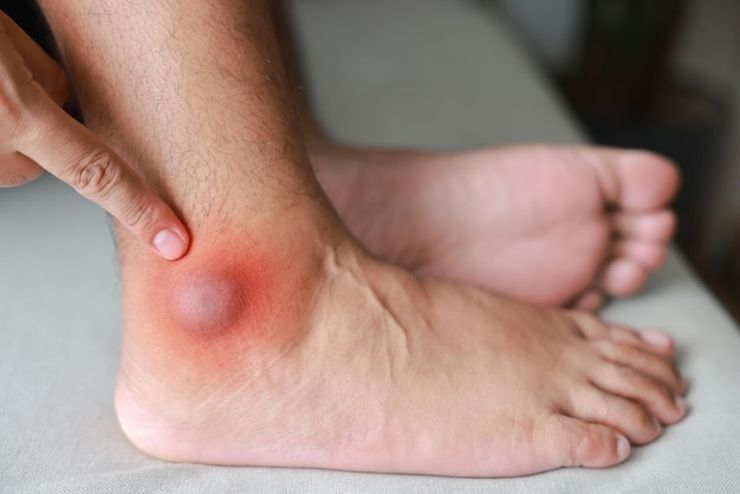
Your big toe, foot, and ankle run cooler than the core of your body, and crystals form more easily in cooler tissue. The first deposits tend to settle there. Over the years, with persistently high urate, crystals accumulate in the ankle, knee, wrist, fingers, elbow, and the soft tissue around joints. Researchers studying a group of 75 people with gout found that when the ankle or wrist was involved in a flare, blood markers of activated inflammation tracked with disease at multiple sites rather than a single isolated joint.
When one deposit triggers a flare, immune chemicals flood the area and can spill into nearby or distant joints where silent crystals already sit. That is why the toe can quiet down while the ankle wakes up. The crystals did not physically travel overnight. They were already there, waiting.
Two patterns you might recognize
The “moving” gout people describe usually falls into one of two buckets.
Several joints at the same time. Toe and ankle together, or both ankles, or a knee plus a wrist. This is true polyarticular gout. It tends to show up in people with a long history of high urate, tophi (hard lumps of crystal under the skin), kidney disease, or diuretic use. It is also more common in older adults and in women after menopause.
One joint after another. The toe settles and within a day or two the ankle or knee takes off. Sometimes this is one long cluster of flares rather than separate attacks, which is why the whole episode can stretch past two weeks. If you recently started or increased allopurinol or febuxostat, shifting urate levels can shake crystals loose from deposits across the body, producing exactly this hopscotch pattern. We covered that in our piece on why starting febuxostat can trigger a flare.
Treatment is different when more than one joint is involved
For a single-joint flare, a clinician can often inject steroid straight into the joint. Quick, local, and it mostly sidesteps stomach and blood-sugar side effects. That option mostly disappears when four joints are involved at once, because you cannot realistically inject all of them.
A multi-joint flare is usually handled with medicine that works through the whole body:
- Colchicine, started as early as possible. The modern regimen comes from a randomized trial of 184 people having early flares: a total of 1.8 mg taken over the first hour worked about as well as the old high-dose schedule, with far less misery. About 38% of people on the low dose had at least half their pain gone by 24 hours, versus about 16% on placebo, and severe diarrhea was confined to the high-dose group.
- A nonsteroidal anti-inflammatory drug (NSAID), such as naproxen (Aleve) or indomethacin, taken at a proper anti-inflammatory dose if your kidneys and stomach can handle it.
- An oral corticosteroid, often the practical choice when several joints are involved or NSAIDs and colchicine are risky because of kidney disease, blood thinners, or diabetes.
The choice depends on your medical history, not on which drug sounds strongest. Kidney function, ulcer history, heart failure, diabetes, and other pills all matter. This is a conversation with a clinician, not a pharmacy guessing game. The home measures still help while the medicine kicks in: rest the joints, ice them for 15 to 20 minutes at a time, keep the limb elevated, drink water, and skip alcohol until the flare is over. We broke down why ice beats heat for gout here.
The warning signs: gout can share a joint with an infection
Here is the part people sometimes miss. A hot, red, swollen joint is not automatically gout, even when you have had gout for years. Septic arthritis, meaning a bacterial infection inside the joint, can look almost identical, and crystals and bacteria can share the same joint fluid. In one 22-year hospital series of 602 confirmed infected-joint samples, urate or calcium pyrophosphate crystals were present in 27% of them, and those samples were more likely to have a misleadingly negative Gram stain. Finding crystals does not let infection off the hook.
Get urgent, in-person care the same day if you have:
- Fever, chills, or feeling generally very unwell with a hot joint.
- Redness spreading quickly past the joint.
- A wound, cut, or skin infection near the swollen area.
- A first-ever hot swollen joint, especially the knee or shoulder, with no clear gout history.
- An immune system weakened by steroids, chemotherapy, or transplant medicine.
When there is doubt, the standard move is to aspirate the joint (draw a small fluid sample) and examine it for both crystals and bacteria, with the fluid cultured. Finding urate crystals in joint fluid or a tophus is enough to settle a gout diagnosis on its own under the 2015 American College of Rheumatology/EULAR classification rules, which showed 92% sensitivity and 89% specificity overall, but that does not cancel the infection check. Untreated septic arthritis can destroy a joint in days, so this is not a “wait and see” situation.
Why polyarticular gout usually means it is time for the long-term fix
Flare pills put out today’s fire. They do nothing about the fuel. If gout is appearing in several joints, the fuel load across your body is high, and treating flare after flare without lowering urate tends to lose ground over time.
The 2020 American College of Rheumatology (ACR) guideline strongly recommends urate-lowering therapy (ULT) for people with tophi, gout-related bone damage visible on imaging, or frequent flares, defined as two or more per year. The UK’s NICE guideline (NG219) puts it in plainer terms: offer ULT to people with multiple or troublesome flares. If your single episode keeps jumping between joints, that usually qualifies as troublesome.
The playbook, per both guidelines:
- Start low. Allopurinol (Zyloprim) is the preferred first choice, commonly starting at 100 mg a day or less, including for many people with chronic kidney disease. Febuxostat (Uloric) is the usual alternative.
- Treat to a target. The dose is nudged up using blood tests until serum urate stays below 6 mg/dL, and below 5 mg/dL when tophi or chronic joint disease are present. Above about 6.8 mg/dL is where crystals can form, so staying below 6 keeps crystals dissolving instead of accumulating.
- Cover the first months. Starting ULT can itself trigger flares as crystals loosen. The ACR strongly recommends anti-inflammatory prophylaxis for at least 3 to 6 months. A pooled analysis of three phase III trials covering 4,101 people showed why stopping cover at 8 weeks led to flare rates climbing as high as 40%, while 6 months of prophylaxis kept rates in the 3% to 5% range. Low-dose colchicine (Colcrys) is the usual cover; a low-dose NSAID is an alternative when colchicine does not suit you.
- Do not stop ULT during a flare. If you already take allopurinol or febuxostat, keep taking it through the flare unless your clinician says otherwise.
One practical note on timing. ACR guidance allows starting ULT even during a flare as long as anti-inflammatory treatment is in place; NICE typically suggests waiting 2 to 4 weeks after the flare settles, while allowing an earlier start when flares come one after another with no clean gap, which is exactly the multi-joint cluster situation. Your clinician will pick the timing for your case.
For a sense of scale, gout affected about 3.9% of US adults, roughly 8.3 million people, in the 2007 to 2008 National Health and Nutrition Examination Survey, and national estimates have drifted upward since alongside obesity and hypertension. The encouraging flip side: gout is one of the few forms of arthritis with a well-defined biochemical target. Get urate below 6 mg/dL and hold it there, and the crystals that drive migrating flares slowly dissolve.
What to do this week
If a flare is moving between joints right now, treat it as one active episode. Start prescribed anti-inflammatory medicine early, ice and elevate, and watch hard for the infection warning signs above. Once things settle, book a follow-up within a few weeks to get a serum urate test, review medicines that may be raising it (water pills are a classic culprit, and we looked at diuretics and gout in depth), and put a concrete urate-lowering plan in place.
If urate was normal during the flare, do not let one normal number end the conversation. Urate often dips during an acute attack, and NICE recommends repeating the test at least 2 weeks after the flare settles. We explained why a normal test during a flare can be misleading.
Pain that hops from toe to ankle to knee is not some mystery disease. It is gout with a bigger crystal footprint, and that is a pattern you can actually do something about.
Frequently asked questions
Can gout be in two joints at the same time?
Yes. Polyarticular gout means a flare involving several joints at once, such as the big toe and ankle together or both knees. It is more common after years of high urate, in older adults, in people taking diuretics, and in those with tophi or kidney disease. Up to half of people over 65 have atypical, multi-joint presentations rather than the classic single-toe flare.
Why does my gout move from my toe to my ankle or knee?
Crystals typically already exist in the next joint before it hurts. Inflammation from the first flare, along with immune chemicals in the bloodstream, can activate those silent deposits. Rapid changes in blood urate, including starting allopurinol or febuxostat without flare prophylaxis, can also set off a chain of flares at different sites over a week or two.
How long can a migrating gout flare last?
A typical first, single-joint flare resolves in roughly 7 to 10 days without treatment, often faster with early treatment. Multi-joint or clustered flares can run up to about 3 weeks. If symptoms stretch past two weeks with no improvement, or keep returning in the same joint, get reassessed to confirm the diagnosis and rule out infection or another type of arthritis.
Does gout in multiple joints mean my case is serious?
It usually signals a larger total body crystal load and often means urate-lowering therapy is overdue, especially if you have had two or more flares in a year, visible tophi, or kidney disease. It does not mean the flare itself is dangerous, but it is a reason to move from treating episodes to controlling the underlying urate level with a treat-to-target plan.
Can a multi-joint flare actually be an infection?
Yes. Gout and septic arthritis can coexist in the same joint. In one large hospital series, crystals were present in 27% of confirmed infected-joint fluid samples. Fever, chills, spreading redness, a nearby skin wound, severe illness, or a first-ever hot swollen joint warrants same-day medical evaluation. Joint aspiration can check for crystals and bacteria at the same time.
Which medicine works best for polyarticular gout?
There is no single best drug. Colchicine, NSAIDs, and oral corticosteroids are all first-line options, chosen around your kidney function, stomach and heart history, diabetes, and other medications. A steroid injection, useful for one joint, is usually impractical when several joints are involved, so whole-body treatment is more common for polyarticular flares.
References
- FitzGerald JD, Dalbeth N, Mikuls T, et al. “2020 American College of Rheumatology Guideline for the Management of Gout.” Arthritis Care & Research. 2020;72(6):744-760. doi:10.1002/acr.24180. PMID: 32391934.
- National Institute for Health and Care Excellence. “Gout: diagnosis and management.” NICE guideline NG219. Published June 9, 2022. https://www.nice.org.uk/guidance/ng219
- Terkeltaub RA, Furst DE, Bennett K, Kook KA, Crockett RS, Davis MW. “High versus low dosing of oral colchicine for early acute gout flare: Twenty-four-hour outcome of the first multicenter, randomized, double-blind, placebo-controlled, parallel-group, dose-comparison colchicine study.” Arthritis and Rheumatism. 2010;62(4):1060-1068. doi:10.1002/art.27327. PMID: 20131255.
- Wortmann RL, Macdonald PA, Hunt B, Jackson RL. “Effect of prophylaxis on gout flares after the initiation of urate-lowering therapy: analysis of data from three phase III trials.” Clinical Therapeutics. 2010;32(14):2386-2397. doi:10.1016/j.clinthera.2011.01.008. PMID: 21353107.
- Kumar M, Manley N, Mikuls TR. “Gout Flare Burden, Diagnosis, and Management: Navigating Care in Older Patients with Comorbidity.” Drugs & Aging. 2021;38(7):545-557. doi:10.1007/s40266-021-00866-2. PMID: 34105100.
- Vedder D, Gerritsen M, Duvvuri B, van Vollenhoven RF, Nurmohamed MT, Lood C. “Neutrophil activation identifies patients with active polyarticular gout.” Arthritis Research & Therapy. 2020;22(1):148. doi:10.1186/s13075-020-02244-6. PMID: 32552822.
- Stirling P. “The Limitations of Gram-stain Microscopy of Synovial Fluid in Concomitant Septic and Crystal Arthritis.” Current Rheumatology Reviews. 2018;14(3):255-257. doi:10.2174/1573397113666170329123308. PMID: 28356052.
- Zhu Y, Pandya BJ, Choi HK. “Prevalence of gout and hyperuricemia in the US general population: the National Health and Nutrition Examination Survey 2007-2008.” Arthritis and Rheumatism. 2011;63(10):3136-3141. doi:10.1002/art.30520. PMID: 21800283.
- Neogi T, Jansen TLTA, Dalbeth N, et al. “2015 Gout Classification Criteria: an American College of Rheumatology/European League Against Rheumatism collaborative initiative.” Annals of the Rheumatic Diseases. 2015;74(10):1789-1798. doi:10.1136/annrheumdis-2015-208237. PMID: 26359487.
- Merck Manual Professional Version. “Gout.” Crystal-Induced Arthritides, Musculoskeletal and Connective Tissue Disorders. https://www.merckmanuals.com/professional/musculoskeletal-and-connective-tissue-disorders/crystal-induced-arthritides/gout
Reviewed by the GoutSavvy Editorial Team