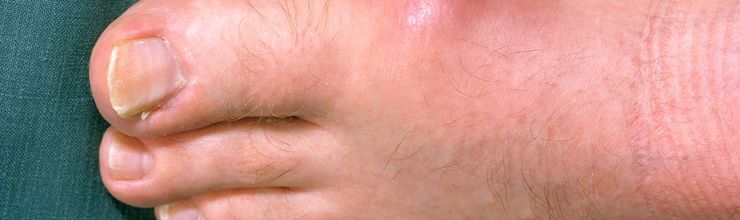
Your toe is throbbing. It is swollen, bright red, and hot enough that even a bedsheet feels like torture. Then you reach for the thermometer, and your stomach drops: 100.9°F (38.3°C). Now you have a second question crowding in beside the pain. Is this still gout, or is something infected in there?
That question is the right one to ask, and it lands at 3 a.m. more often than not. If the timing itself has you curious, we covered why flares so often wake you up separately. Here is the short version, before we get into the details: a gout attack can raise your temperature, especially when the flare is severe or hits more than one joint. But fever is also the warning sign of a joint infection, which can wreck a joint in days and occasionally costs a life. The two can look nearly identical at first, and you cannot safely sort it out by staring at your foot.
So Can a Gout Attack Really Give You a Fever?
Yes. It is not common with a mild flare, but it is real, and doctors have known it for a long time.
The crystals that cause gout, needle-shaped monosodium urate crystals, set off a heavy immune reaction. Your white blood cells pile into the joint, and a protein complex called the NLRP3 inflammasome gets activated. That pumps out interleukin-1 beta (IL-1β), the same signal your body uses when it fights bacteria. IL-1β, along with interleukin-6 and tumor necrosis factor-alpha, can literally reset your body’s thermostat upward. These are pyrogens, fever-making molecules, and gout produces them without any infection being present at all.
A classic study published in 1974 looked at 41 people admitted with sudden gout in several joints at once. Fever, elevated white blood cell counts, and even normal-looking uric acid levels each showed up in close to half of them. When the inflammation was treated, the fever dropped within 4 to 6 hours. Older people were hit hardest, and reviews note that the more joints are involved, the more likely a fever becomes.
It is not always just a temperature. People describe feeling wiped out, shivery, and off their food, basically flu symptoms parked on top of a screaming joint. A 2021 review in the Journal of Clinical Medicine spells this out plainly: fever and fatigue are not uncommon during a gout attack, and a severe multi-joint flare can occasionally present as a body-wide, sepsis-like condition in the hospital.
One more wrinkle worth knowing. Gout can occasionally cause prolonged, unexplained fever. Japanese doctors reported the case of a 61-year-old man who ran a fever for three months while infection tests came back negative over and over. His blood uric acid was not even elevated. A needle sample from his swollen knee finally showed urate crystals. Treat the gout, and the three-month fever ended. The lesson cuts two ways: gout can fool everyone, but finding out took a joint tap, not a guess.
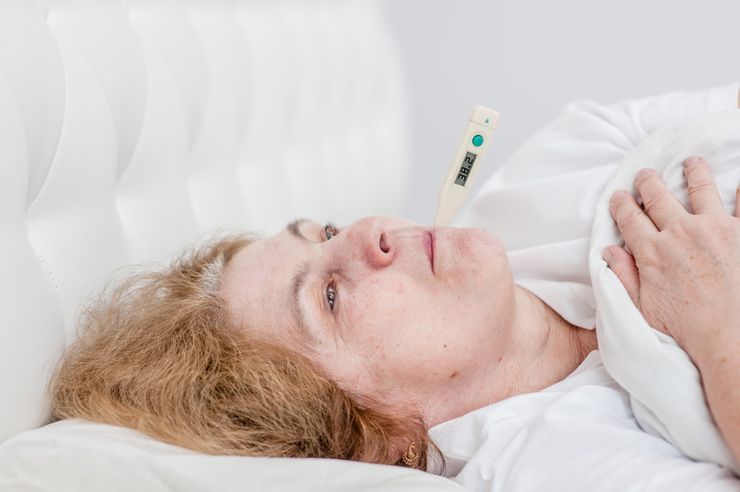
Fever or Infection: Why Even Doctors Can Get It Wrong
This is the part that matters most. The single most dangerous thing a hot, swollen joint can be is septic arthritis, meaning bacteria have invaded the joint space. Gout and septic arthritis share the same opening act: rapid pain, swelling, redness, warmth, fever, and a high white blood cell count. A textbook even states the obvious: gout with fever and elevated white cells can be hard to tell apart from a joint infection.
The numbers show why nobody can afford to assume. In a New Zealand audit of 248 medically admitted cases of native joint septic arthritis, the death rate was 2 percent at 30 days and 6 percent at 90 days. About 15 percent of the infected people also had gout underneath, which is exactly the overlap that causes confusion.
Worse, the two conditions are not mutually exclusive. A Spanish series described 25 people who had crystals and a proven infection in the same joint at the same time. Their average age was 67, the knee was the usual target, and 8 percent died. Finding urate crystals does not prove the joint is sterile. You have to culture the fluid too.
And when gout and infection coexist, outcomes get uglier. A Singapore surgical series found that people with both conditions stayed in the hospital about 12.6 days longer on average after the researchers adjusted for other factors, and 23 percent ended up needing an amputation on the univariate analysis. Gout did not make the infection harmless. It helped hide it.
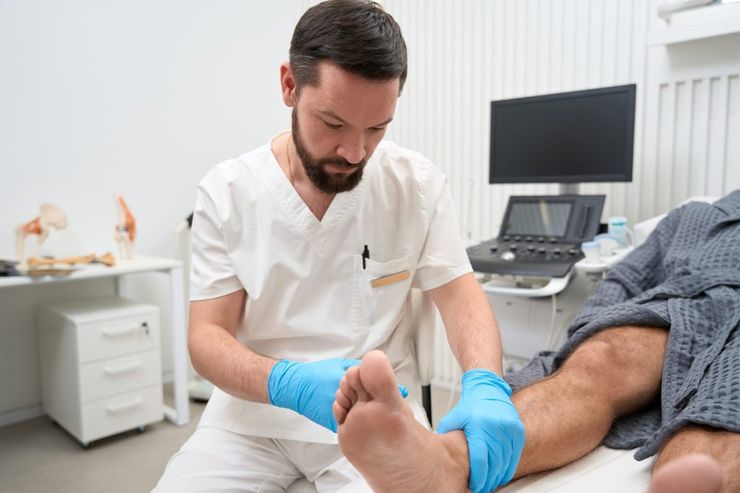
So how does the call actually get made? With a needle. Arthrocentesis means drawing a small amount of synovial fluid from the swollen joint, the one test that settles it. Under a polarized-light microscope, urate crystals look like tiny needles. The same fluid gets a white cell count, a Gram stain, and a culture. Gout fluid is inflammatory but sterile, and the white cell count in gout commonly lands between about 10,000 and 60,000 cells per cubic millimeter, occasionally higher, so count alone cannot rule infection in or out. What seals the infection diagnosis is organisms visible on the stain or growing in the culture. Blood tests like CRP and procalcitonin add context, but they do not replace the tap.
When Your Fever Means Get Help Now
You are not expected to diagnose this on your own. What you can do is know the danger patterns and react to them. The UK’s National Health Service advises urgent medical help when sudden joint pain and swelling come with a very high temperature or with feeling hot, cold, and shivery.
Get evaluated promptly, and skip the wait-and-see approach, if any of these fit:
- A hot, swollen joint plus shaking chills or rigors, the kind of shaking you cannot control.
- A first-ever attack. If you have never had gout confirmed by a doctor, a red hot joint is an emergency until infection is ruled out, not a reason to borrow someone else’s pills. Not sure what a first attack looks like? Our guide to what to do in the first 12 hours walks through it.
- Fever that keeps climbing instead of drifting down, or fever that lasts beyond the first couple of days.
- Several joints flaring at once, or redness and swelling spreading past the joint into the surrounding skin, which could also be cellulitis.
- Confusion, faintness, a racing pulse, or feeling genuinely systemically ill.
- Any break in the skin over the joint, including a bursting or leaking tophus, because that gives bacteria a door in.
- A gout flare that simply does not respond the way it usually does to your prescribed treatment.
None of these symptoms automatically means infection. Gout alone can produce most of them. They mean you cannot tell the difference safely at home, and the cost of being wrong is high.
What to Do While You Arrange Care
If you have a known gout diagnosis and a typical flare with just a slight temperature, the playbook has not changed. Start your prescribed flare medication early, because the sooner treatment begins the better it works. If your usual pills have been letting you down lately, it may be worth reading up on why gout medication sometimes stops working. Rest the joint, keep it elevated above heart level, and ice it through a thin cloth for 15 to 20 minutes at a time. Drink water. Take weight off it, and keep the bedding lifted away from the skin if even the sheet hurts.
Do not start antibiotics yourself, and do not talk yourself out of an evaluation because “gout can cause fever.” That fact is not a get-out-of-jail card. Also avoid the home-temperature traps that make gout worse in the first place: skip alcohol, heavy meals, and crash dieting while you recover, since all of them can shove uric acid around and intensify the attack.
For the long run, the 2020 American College of Rheumatology guideline recommends urate-lowering treatment for people with frequent flares, tophi, or joint damage from gout, with allopurinol as the usual first choice and a target serum urate below 6 mg/dL. Our plain-language breakdown of what your uric acid numbers actually mean can help you track whether treatment is getting you there. Fewer severe flares means fewer of these fever-scare episodes. An estimated 9.2 million Americans had gout in 2015 to 2016, roughly 3.9 percent of adults, and most severe, recurrent flares are preventable once urate is actually controlled.
Frequently Asked Questions
How high of a fever can gout cause?
Most gout-related fevers run low grade, meaning a mild elevation rather than a spiking temperature. Severe and multi-joint attacks can push it higher. There is no safe cutoff where “gout stops” and “infection begins,” which is why a high fever with a hot joint deserves a medical evaluation regardless of your gout history.
I have gout and a fever of 100.4°F (38°C). Should I panic?
Do not panic, but do not ignore it either. A mild fever can be part of a bad flare. Check whether the joint and fever are improving with your usual treatment, contact your doctor the same day if this is a first episode or anything feels unusual, and seek urgent care if the temperature rises, chills start, or you feel seriously ill.
Can gout be mistaken for a joint infection?
Often, yes, even by experienced clinicians. Both produce a hot, swollen, painful joint with fever and elevated inflammatory markers. The reliable way to separate them is arthrocentesis, drawing joint fluid to look for urate crystals, bacteria, and culture growth. Sometimes both are present in the same joint, so the fluid needs both tests.
Is a joint tap painful, and is it really necessary?
The needle is thin, the procedure is quick, and the skin is usually numbed first. Most people are surprised how tolerable it is, especially compared with the flare itself. When fever and a hot joint are on the table, it is the one test that can rule out an infection that could destroy the joint or spread into the bloodstream, so it is usually the correct call.
Should I keep taking allopurinol during a feverish flare?
Generally, yes, continue your prescribed urate-lowering medicine at the same dose during a flare unless your doctor tells you otherwise. Stopping and restarting it can itself trigger more attacks. That said, fever means getting checked: starting, stopping, or changing gout medication on your own is not the solution to either a flare or an infection.
The bottom line is simple. Gout can raise your temperature, because the same immune machinery that makes your toe explode can also make you feel fluish and feverish. But a hot joint with fever is a shared address, and septic arthritis lives there too. If this is your first attack, the fever is high or climbing, the chills won’t stop, or the flare isn’t behaving like your usual ones, get the joint tapped. A quick needle test is a fair trade for not gambling with a joint, or worse.
References
- Hadler NM, Franck WA, Bress NM, Robinson DR. “Acute polyarticular gout.” The American Journal of Medicine. 1974;56(5):715–719. doi:10.1016/0002-9343(74)90639-1 PMID: 4825606.
- Galozzi P, Bindoli S, Doria A, Oliviero F, Sfriso P. “Autoinflammatory Features in Gouty Arthritis.” Journal of Clinical Medicine. 2021;10(9):1880. Article number 1880. doi:10.3390/jcm10091880 PMID: 33926105.
- Kato M, Oishi Y, Inada M, Tokuda Y. “Advanced erosive gout as a cause of fever of unknown origin.” Korean Journal of Family Medicine. 2015;36(3):146–149. doi:10.4082/kjfm.2015.36.3.146 PMID: 26019765.
- Kennedy N, Chambers ST, Nolan I, Gallagher K, Werno A, Browne M, Stamp LK. “Native joint septic arthritis: epidemiology, clinical features, and microbiological causes in a New Zealand population.” The Journal of Rheumatology. 2015;42(12):2392–2397. doi:10.3899/jrheum.150434 PMID: 26523022.
- Prior-Español Á, García-Mira Y, Mínguez S, Martínez-Morillo M, Gifre L, Mateo L. “Coexistence of septic and crystal-induced arthritis: a diagnostic challenge. A report of 25 cases.” Reumatología Clínica (English Edition). 2019;15(6):e81–e85. doi:10.1016/j.reuma.2017.12.015 PMID: 29398463.
- Hong CC, Chan MC, Wu T, Toh M, Tay YJ, Tan JH. “Does concomitant gout in septic arthritis affect surgical outcomes?” Injury. 2023;54(2):409–415. doi:10.1016/j.injury.2022.10.028 PMID: 36351859.
- FitzGerald JD, Dalbeth N, Mikuls T, et al. “2020 American College of Rheumatology guideline for the management of gout.” Arthritis Care & Research. 2020;72(6):744–760. doi:10.1002/acr.24180 PMID: 32391934.
- Chen-Xu M, Yokose C, Rai SK, Pillinger MH, Choi HK. “Contemporary prevalence of gout and hyperuricemia in the United States and decadal trends: the National Health and Nutrition Examination Survey, 2007–2016.” Arthritis & Rheumatology. 2019;71(6):991–999. doi:10.1002/art.40807 PMID: 30618180.
- Menon SG, Rednam M, Gujarathi R, Maher L. “Gout.” StatPearls. StatPearls Publishing; updated 2026. Book accession NBK546606. PMID: 31536213. Available at: https://www.ncbi.nlm.nih.gov/books/NBK546606/
- National Health Service. “Gout.” NHS website. Available at: https://www.nhs.uk/conditions/gout/
Reviewed by the GoutSavvy Editorial Team