Three in the morning, and your big toe feels like someone drove a nail through it. The sheets alone are torture. Then comes the practical question you did not know you would have: can you even walk to the bathroom, or should you crawl?
A lot of people with gout try to “walk it off.” The thinking is understandable. Keep the joint loose, stay moving, do not let it stiffen up. It works for a sore back, so why not a gout flare?
Because a gout flare is not a stiff muscle. Walking on a swollen, crystal-inflamed joint usually makes the pain worse and can drag the attack out. Here is what the guidelines and the research actually say about resting, walking, elevating, icing, and the pair of compression socks sitting in your drawer.
Why walking on a flared joint backfires
Gout starts when sharp monosodium urate crystals collect in a joint. Your immune system notices those crystals and floods the area with inflammatory cells. The joint swells, heats up, turns red, and becomes so tender that even light pressure hurts. Doctors validate flares partly by checking exactly those signs: pain at rest, a swollen joint, a warm joint, plus your own sense that “this is a gout attack.” A study of 509 people with gout across 17 centers found that meeting at least 3 of those 4 criteria identified a real flare with 85% sensitivity and 95% specificity (PMID: 29161469).
Now imagine putting your full body weight on top of all that. Every step squeezes tissue that is already swollen, raises pressure and temperature inside the joint, and mechanically irritates the lining the crystals are attacking. You are not “working the crystals loose.” Crystals do not get walked out. They dissolve slowly, over months, once your blood urate stays low.
The UK’s National Health Service puts its advice bluntly on its patient page: during an attack, rest and raise the limb, and do not put pressure on the joint because it makes the pain worse (NHS, Gout). That matches what rheumatologists tell people in clinic. The first day or two of a flare is for getting off the foot, not hitting a step goal.
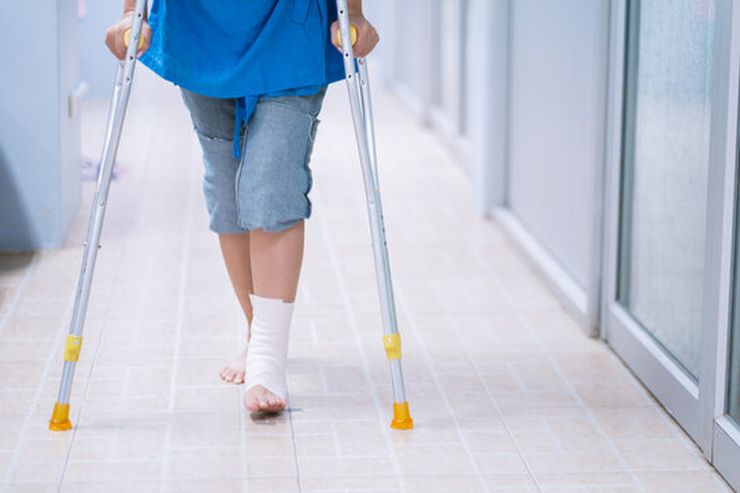
If you have to get up for the bathroom or the fridge, use whatever takes weight off the joint. A cane held in the opposite hand, crutches, a supportive slipper or open-toed shoe with a stiff sole. Hop if you must. Anything beats limping barefoot across a hard floor.
Rest the joint, not your whole life
“Rest” here means protect the one angry joint. It does not mean bed rest for a week. Sit or lie down, prop the foot up, and keep doing everything you can do without loading it. Remote work, desk chores, cooking from a chair, all fair game.
One thing worth keeping off the joint at night is the bedding itself. The NHS specifically advises keeping bedclothes away from the affected joint (NHS, Gout). A foot cradle, a pile of pillows holding the blanket up, or even sleeping with your foot outside the covers can save you from that 4 a.m. wake-up when the sheet shifts. It sounds trivial until a bedsheet is the worst thing you have ever felt.
Raise it above your heart
Elevation is free, has no side effects, and pairs with rest. Prop the foot or ankle up on pillows so it sits above the level of your heart when you lie back. Fluid that pooled in the joint overnight has somewhere to drain instead of sitting there throbbing. Do not expect elevation to stop the flare on its own. It will not. Nothing home-based replaces the anti-inflammatory medication, but less swelling means less pain while the medication catches up.
For a knee flare, stack pillows under the calf rather than directly behind the knee, so the leg stays almost straight and nothing presses into the joint.
Ice actually has a small trial behind it
Cold is one of the few home measures with a randomized study attached, small as it is. Researchers split 19 people having an acute gout attack into two groups. Both got prednisone and colchicine, but one group also applied ice. After a week, the ice group reported a mean pain drop of 7.75 cm on a 10 cm scale, against 4.42 cm in the medication-only group, a statistically significant difference (p = 0.021) (PMID: 11838852). Swelling did not differ significantly, and the study was tiny, so read it with caution. The Cochrane review on lifestyle measures for acute gout found this same trial was the only one that qualified, and rated the evidence low certainty (PMID: 24186771).
That lines up with the official guidance. The 2020 American College of Rheumatology (ACR) guideline conditionally suggests ice as an add-on to medication, and Britain’s NICE guideline NG219 tells clinicians to advise people that ice packs, used together with prescribed medicine, may help ease the pain (NICE NG219, recommendation 1.3.5).
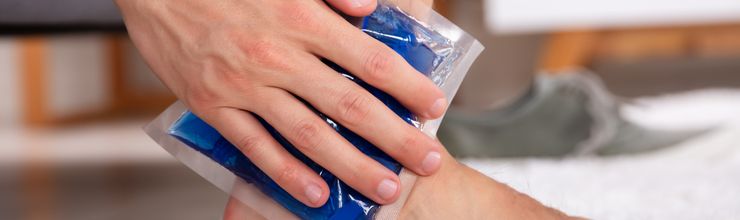
The practical version: wrap an ice pack or a bag of frozen peas in a towel, hold it against the joint for up to 20 minutes at a time, and repeat through the day as needed. Never put bare ice on skin. Ice is an add-on, not a substitute for the medicine. For the details on why heat is the wrong move during a hot flare, see the piece on ice versus heat for a gout flare.
What about compression socks?
This is where the internet gets pushy, because compression sock vendors have a lot of pages and the gout evidence has almost none.
No major gout guideline recommends compression during an acute flare, and the Cochrane review found no qualifying trial testing it for acute gout at all (PMID: 24186771). Think about what a tight sock does in the first 48 hours. It squeezes a joint that is already hot and swollen, traps fabric over the most tender spot on your body, and adds pressure the joint is actively telling you it cannot take. Most people who try firm compression at the peak of a flare rip the sock off within minutes. Trust that reaction.
Once the red-hot phase has passed, some people like light, loose compression for the puffy, achy foot that lingers for days afterward, and it is a reasonable comfort experiment. Pick a mild pressure, open-toe if the big toe is involved, put it on in the morning before swelling builds, and take it off the moment anything throbs or goes numb. This is comfort, not treatment, and nobody should be sold compression as a gout remedy.
Your shoes matter more than you think
If you must be upright during a flare, what is on your foot decides how much it costs you. Foot problems are a real, underrated part of gout, and the footwear research is a little brutal. A study of 50 people with gout recruited from rheumatology clinics found worn-out, unsupportive shoes were common, over half the shoes inspected were at least 12 months old with heavy wear, and people in poor footwear reported more foot-related impairment and disability. When patients chose shoes, comfort (98%), fit (90%), and support (90%) were the deciding factors (PMID: 21972234).
During a flare, the rules are simple. Wide toe box so nothing presses the first toe joint, soft uppers that give as the foot swells, a sole stiff enough that bending the shoe does not bend your toe with it, and a strap or lace you can loosen through the day. Old running shoes with dead foam, flat canvas slip-ons, dress shoes, and boots come off until the swelling is gone. If even a sock is too much, a surgical shoe or open sandal for a few days is not vanity, it is damage control.
The medicine is the main event. Start it early.
Rest, ice, elevation, and shoes are supporting cast. The thing that actually shortens a flare is anti-inflammatory medication started early. The ACR strongly recommends nonsteroidal anti-inflammatory drugs (NSAIDs), colchicine, or glucocorticoids as first-line flare treatment (PMID: 32391934), and the European Alliance of Associations for Rheumatology (EULAR) recommends the same three families (PMID: 27457514). The NHS tells patients to take prescribed flare medicine as soon as possible, with improvement usually visible within 2 days (NHS, Gout).
Which one fits you depends on your kidneys, stomach, blood pressure, and other medicines, so work this out with your clinician before the next attack, not during it. Keep the rescue prescription at home. If over-the-counter ibuprofen barely dents your pain, that is common and there are better options; the breakdown is in the piece on why ibuprofen stops working for gout. And do not stop or start your daily urate-lowering pill in a panic without guidance. Changing urate fast can lengthen the flare; the rules are explained in the febuxostat flare-start study piece.
When is it safe to walk again?
Wait for the joint, not the calendar. The redness and the heat fade first, usually a day or two after medication kicks in. Then the sharp pain softens into a dull ache, and the swelling starts going down. That is your green light to move.
Start small. Wiggle the toes or circle the ankle while sitting. Walk around the house in supportive shoes for a few minutes at a time. If walking makes the joint hotter, bigger, or more painful the next day, you pushed too soon, and you go back to rest. Gentle range-of-motion work is fine. Full workouts, running, and long shifts on concrete wait until you can walk normally without limping, often around day 4 to 7 of a treated flare. Knee flares tend to take longer than toe flares.
Once the flare is gone, walking is genuinely protective
Here is the twist worth sitting with. Walking is the enemy during a flare and one of your better friends between them.
A 2025 analysis of 97,387 UK Biobank adults wearing wrist accelerometers found 833 new gout cases over a median 8 years. People whose moderate-to-vigorous activity was spread regularly across the week were less likely to develop gout than inactive people, even after adjusting for baseline urate (hazard ratio 0.79, 95% CI 0.65 to 0.98) (PMID: 41454374). A separate 2026 UK Biobank study of 86,930 accelerometer-tracked adults found the same pattern for walking specifically. Among people at the highest genetic risk for gout, moderate walkers had a 32% lower rate of new gout and high-volume walkers a 45% lower rate, compared with the least active group (PMID: 41452761). Regular daily movement beat cramming exercise into one or two weekend days.
So the full picture is not “gout means rest forever.” It is: rest hard during the acute attack, get moving the moment the joint allows it, and build a daily walking habit that may genuinely lower your odds of the next one. If flares keep waking you up anyway, the nighttime flare piece covers why 3 a.m. is gout’s favorite hour.
When rest is not enough
Most treated flares bend within 2 days and clear inside a week to 10 days. An untreated attack commonly runs 1 to 2 weeks (NHS, Gout). Get urgent medical attention if the pain keeps climbing instead of plateauing, you run a fever or feel hot and shivery, you cannot eat or keep fluids down, or the skin breaks. An infected joint can look almost identical to a severe gout flare, and it cannot wait. Seek help as well if a flare is not improving after a few days on proper medication; the drug choice or dose may need rethinking, especially if gout has started hitting more than one joint at once.
The short version: in the first 48 hours, offload the joint, raise it, ice it through a towel for 20 minutes at a time, skip the tight socks, and take the medicine early. Then let your symptoms set the schedule for the first walk. Protect the joint now so you can put in the miles later. The miles, as it turns out, help protect you back.
Frequently asked questions
Is it better to walk or rest during a gout flare?
Rest the affected joint during the hot, painful phase, usually the first 24 to 48 hours. Walking on an actively flared toe, ankle, or knee raises pressure and temperature in an already inflamed joint and commonly worsens the pain. Keep moving in ways that do not load the joint, and return to walking once redness, heat, and sharp pain are clearly easing.
Will walking “push the crystals out” of my joint?
No. Urate crystals do not get walked out or shaken loose. They dissolve slowly when blood urate stays below about 6 mg/dL through urate-lowering treatment. Mechanical pressure during a flare only irritates the joint lining. Long-term, regular walking may help prevent gout through metabolic and weight effects, which is a different question from forcing movement mid-flare.
Can I wear compression socks during a gout attack?
Skip firm compression during the peak flare. No gout guideline recommends it, no trial has tested it for acute gout, and squeezing a hot, swollen joint usually just adds pain. After the worst phase, a light, open-toe compression sock is fine to try for lingering puffiness, but it is a comfort measure, not a treatment.
How long should I elevate my foot for gout?
Elevate whenever you are sitting or lying down during the first few days, with the foot above heart level on pillows. There is no fixed session length. Combine elevation with rest, towel-wrapped ice for up to 20 minutes at a time, and your prescribed anti-inflammatory medicine, which is the part that actually ends the flare.
When should I worry enough to seek urgent care?
Get urgent help for worsening pain with a fever, chills, or feeling hot and shivery, inability to eat or drink, red streaks or broken skin over the joint, or anything that feels different from your usual flares. Septic arthritis mimics gout and needs immediate treatment. Also seek care if a treated flare is not improving after several days.
References
- FitzGerald JD, Dalbeth N, Mikuls T, et al. “2020 American College of Rheumatology Guideline for the Management of Gout.” Arthritis Care & Research. 2020;72(6):744-760. doi:10.1002/acr.24180. PMID: 32391934.
- Richette P, Doherty M, Pascual E, et al. “2016 updated EULAR evidence-based recommendations for the management of gout.” Annals of the Rheumatic Diseases. 2017;76(1):29-42. doi:10.1136/annrheumdis-2016-209707. PMID: 27457514.
- National Institute for Health and Care Excellence. “Gout: diagnosis and management.” NICE guideline NG219. Published June 9, 2022. Recommendation 1.3.5 (ice packs as adjunct to prescribed medicine). https://www.nice.org.uk/guidance/ng219/chapter/Recommendations
- NHS. “Gout.” National Health Service patient guidance (rest and raise the limb, ice up to 20 minutes, keep bedclothes off the joint, avoid pressure; untreated attacks last 1 to 2 weeks). https://www.nhs.uk/conditions/gout/
- Moi JH, Sriranganathan MK, Edwards CJ, Buchbinder R. “Lifestyle interventions for acute gout.” Cochrane Database of Systematic Reviews. 2013;2013(11):CD010519. doi:10.1002/14651858.CD010519.pub2. PMID: 24186771.
- Schlesinger N, Detry MA, Holland BK, et al. “Local ice therapy during bouts of acute gouty arthritis.” The Journal of Rheumatology. 2002;29(2):331-334. PMID: 11838852.
- Gaffo AL, Dalbeth N, Saag KG, et al. “Brief Report: Validation of a Definition of Flare in Patients With Established Gout.” Arthritis & Rheumatology. 2018;70(3):462-467. doi:10.1002/art.40381. PMID: 29161469.
- Rome K, Frecklington M, McNair P, Gow P, Dalbeth N. “Footwear characteristics and factors influencing footwear choice in patients with gout.” Arthritis Care & Research. 2011;63(11):1599-1604. doi:10.1002/acr.20582. PMID: 21972234.
- Wang Q, Liu Y, Zhu B. “Accelerometer-derived physical activity patterns and risk of incident gout: a prospective cohort study of 97,387 UK Biobank participants.” Arthritis Research & Therapy. 2025;28(1):38. doi:10.1186/s13075-025-03716-3. PMID: 41454374.
- Wu Z, Hu Y, Wang Y, et al. “Genetic susceptibility, walking activity and the risk of incident gout.” Rheumatology (Oxford). 2026;65(2):keaf690. doi:10.1093/rheumatology/keaf690. PMID: 41452761.
Reviewed by the GoutSavvy Editorial Team