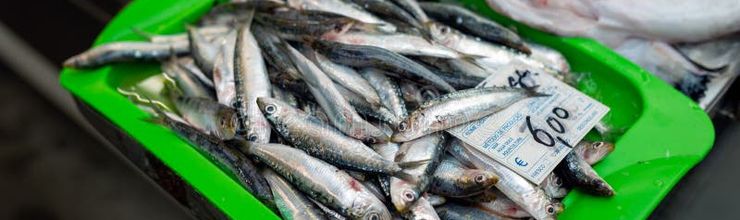
Open a can of sardines and the internet splits in two. One corner calls them the cheapest, healthiest protein you can buy, packed with omega-3, calcium, and vitamin D. The other corner, every gout “avoid” list, puts sardines right near the top, next to anchovies and organ meat.
If you deal with gout, which one is it? Are these little fish a budget superfood or a flare waiting to happen? The honest answer sits in between, and the details actually matter for your next trip down the canned-fish aisle.
Why sardines keep landing on gout “avoid” lists
Gout starts with uric acid. Your body makes it when it breaks down purines, compounds found in your own cells and in food. Eat a big load of purines, and blood uric acid can climb. In a Japanese HPLC analysis that measured 270 foods, fresh sardine came in at 210.4 mg of total purines per 100 g, which put it in the authors’ “high” group.1
To put that in perspective, chicken breast measured 141.2 mg and salmon 119.3 mg per 100 g in the same tables.1 So sardines do carry more purine than the everyday fish and poultry most people compare them to.
Then there is the form people actually eat. Sardines are small enough that you usually eat the whole fish, skin and organs included, rather than a clean fillet. Organs tend to be purine-dense, which is the same reason the 2020 American College of Rheumatology guideline puts seafood and organ meats in the “limit” column for people with gout.8
Here is the catch: not all of that purine counts the same
Before you dump every tin in the cupboard, look at what those 210.4 mg are made of. In the fresh sardine sample, roughly 105.8 mg was guanine, about half the total. Hypoxanthine was 87.1 mg, with smaller amounts of adenine.1
Why does that matter? The same lab, drawing on feeding studies, notes that guanine has not been reported to change blood uric acid levels or urinary uric acid excretion. Hypoxanthine is the base that pushes serum uric acid up more reliably.1 A fish that looks alarming on a “total purine” chart may carry a fair chunk of its load as guanine, the part that does not show up in your blood the same way.
This lines up with what the researchers themselves concluded. They wrote that moderate intake of oily, metallic-skinned fish can fit in the diet of people with gout, partly because the guanine-rich load does not appear to raise uric acid much and partly because these fish lower cardiovascular risk, which matters a great deal when gout and heart trouble travel together.1
None of that turns sardines into a free pass. It does mean “sardines = instant flare” is too simple.
What the flare studies actually found
The strongest test is not a food table but what happens when people with gout eat fatty fish. In the Boston University Online Gout Study, researchers tracked 724 people with confirmed gout and compared what they ate in the 48 hours before an attack with flare-free periods.
Eating any amount of fatty fish, a category that explicitly included sardines, anchovies, salmon, mackerel, herring, and trout, was tied to a 33% lower risk of a flare (adjusted odds ratio 0.77). Two or more servings worked out to an adjusted odds ratio of 0.74. Self-directed fish oil supplements, by contrast, showed no link to fewer flares, with an odds ratio of 1.01.2
Read that carefully. It is not proof that sardines prevent flares. It is an association in one study, and the people eating fish may have differed in other ways. But it is hard to look at those numbers and argue that a normal serving of sardines is a proven, dependable trigger.
A large NHANES analysis of 12,505 U.S. adults pointed in a similar direction from another angle. Higher intake of seafood low in omega-3 was tied to about an 8.7% higher odds of gout, while omega-3 rich seafood was no longer significantly linked to gout once other factors were adjusted for.3 Sardines fall on the omega-3 rich side of that split.
The older, longer-term picture is the reason the caution exists. In the 12-year Harvard cohort of 47,150 men with no history of gout, the men who ate the most seafood developed gout at a 51% higher rate than those who ate the least (relative risk 1.51).4 That is about steady, high seafood intake over years, not a single tin, and it is the study behind the standard “limit seafood” advice.
Fresh, canned, dried, half-dried: the form genuinely matters
This is the part people miss. “Sardines” covers very different products, and the purine numbers swing hard depending on how much water has been removed.
Half-dried sardine measured 305.7 mg of purines per 100 g, up from 210.4 fresh, because drying pulls out moisture and leaves the purines more concentrated.1 Niboshi, the dried baby sardines used in Japanese stock and snacks, measured 746.1 mg per 100 g.1 Dried anchovy, a close relative, reached 1108.6 mg per 100 g. These are the forms a person with frequent flares should treat most carefully, even though a single niboshi is tiny and they are often used for flavor rather than eaten by the handful.
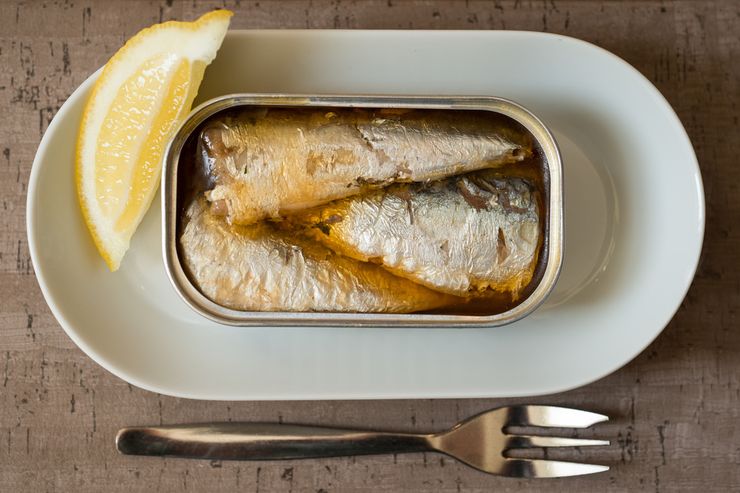
Canned sardines sit closer to the fresh end than to the dried end, since the fish retains most of its moisture in the tin. Exact values vary by brand and packing liquid, and the honest move is not to pin a single precise number on all cans. A water-packed fish and an oil-packed fish are not identical. What does not change is that canned sardines are still the whole, oily fish, with the same high-quality protein and omega-3 to show for it.
How you cook other seafood matters too; purines leach into cooking water, which is one reason boiling and discarding the liquid can lower the load, though that matters more for foods you cook at home than for something you eat straight from a can.
So what should you actually do?
A reasonable, evidence-faithful approach looks like this.
If your gout is well controlled and flares are rare, an occasional can of sardines is unlikely to be the thing that tips you over, and the fatty-fish evidence is at least as reassuring as it is alarming. Treat them like other seafood in the Harvard study, a food to rotate and enjoy in modest portions a few times a week at most, rather than a daily habit. Pair them with low-purine sides and skip the old habit of building a whole “high-purine stack” in one meal. If you want other low-friction protein options, eggs are close to purine-free, and even salmon runs lower than its reputation in measured tables.
If flares come often, or you are living with kidney disease, lean toward the cautious end and keep dried, half-dried, and heavily concentrated fish products out of regular rotation. Those carry the genuinely big numbers. And know that diet is a modest lever next to treatment. If you are starting urate-lowering medication, the first weeks can actually bring a flare as crystals shift, which catches people off guard; sticking with the medication is what dissolves deposits over time.
Do not bother chasing sardine benefits through supplements on the assumption that a pill replaces the fish. The study found self-directed fish oil did not cut flares, even though eating the real fish tracked with fewer of them.2 If coffee is part of your routine, there is better news there, and the data on coffee and gout is genuinely reassuring.
Bottom line: sardines are not the villain some avoid lists make them, and not the free superfood the hype promises either. For most people with gout, a small can now and then fits a varied diet just fine. Save the real caution for the dried and concentrated versions, keep seafood intake moderate overall, and put most of your energy into staying on treatment and keeping uric acid down.
Frequently asked questions
Are canned sardines bad for gout?
Canned sardines are a high-purine food by total count, around 210 mg per 100 g for fresh sardine in measured tables, but much of that load is guanine, which does not raise blood uric acid the way hypoxanthine does. In a study of 724 people, eating fatty fish including sardines was tied to fewer, not more, flares. An occasional can is usually fine for someone with well-controlled gout.
Do sardines trigger gout attacks?
No single study has shown that a normal serving of sardines reliably triggers an attack. High long-term seafood intake did raise gout rates in a 12-year study of men, but short-term fatty fish consumption tracked with a lower flare risk. Dried and half-dried sardines, which are far more concentrated, are the forms most worth avoiding.
Which is worse for gout, sardines or anchovies?
Both sit in the top tier, and dried anchovies measured even higher than dried sardines in the Japanese tables, about 1109 mg versus 746 mg per 100 g. Fresh or canned, the two are close enough that it makes sense to treat them similarly, moderate portions, rotated rather than eaten daily.
Can I get omega-3 without the purines?
Yes. Plant sources such as walnuts, flaxseed, and canola oil carry alpha-linolenic acid with almost no purines, though your body has to convert it. Oddly, the gout study found fish oil supplements did not reduce flares even though eating fatty fish did, so food and pills are not interchangeable for this purpose.
How often can I eat sardines if I have gout?
For someone with infrequent flares, a small can a few times a week at most, rotated with other proteins, is a reasonable place to start. If flares are frequent or you have kidney disease, keep it occasional and avoid dried or half-dried sardine products. Track your own response, since individual tolerance varies.
References
- Kaneko K, Aoyagi Y, Fukuuchi T, Inazawa K, Yamaoka N. “Total Purine and Purine Base Content of Common Foodstuffs for Facilitating Nutritional Therapy for Gout and Hyperuricemia.” Biological & Pharmaceutical Bulletin. 2014;37(5):709-721. PMID: 24553148. doi:10.1248/bpb.b13-00967
- Zhang M, Zhang Y, Terkeltaub R, Chen C, Neogi T. “Effect of Dietary and Supplemental Omega-3 Polyunsaturated Fatty Acids on Risk of Recurrent Gout Flares.” Arthritis & Rheumatology. 2019;71(9):1580-1586. PMID: 30908893. doi:10.1002/art.40896
- Zeng G, You J, Wang Y, et al. “n-3 PUFA Poor Seafood Consumption Is Associated with Higher Risk of Gout, Whereas n-3 PUFA Rich Seafood Is Not: NHANES 2007-2016.” Frontiers in Nutrition. 2023;10:1075877. PMID: 37081920. doi:10.3389/fnut.2023.1075877
- Choi HK, Atkinson K, Karlson EW, Willett W, Curhan G. “Purine-Rich Foods, Dairy and Protein Intake, and the Risk of Gout in Men.” New England Journal of Medicine. 2004;350(11):1093-1103. PMID: 15014182. doi:10.1056/NEJMoa035700
- Zhang Y, Chen C, Choi H, et al. “Purine-Rich Foods Intake and Recurrent Gout Attacks.” Annals of the Rheumatic Diseases. 2012;71(9):1448-1453. PMID: 22648933. doi:10.1136/annrheumdis-2011-201215
- Choi HK, Liu S, Curhan G. “Intake of Purine-Rich Foods, Protein, and Dairy Products and Relationship to Serum Levels of Uric Acid: The Third National Health and Nutrition Examination Survey.” Arthritis and Rheumatism. 2005;52(1):283-289. PMID: 15641075.
- Takayanagi F, Fukuuchi T, Yamaoka N, Kaneko K. “Measurement of the Total Purine Contents and Free Nucleosides, Nucleotides, and Purine Bases Composition in Japanese Anchovies (Engraulis japonicus) Using High-Performance Liquid Chromatography with UV Detection.” Nucleosides, Nucleotides & Nucleic Acids. 2020;39(10-12):1458-1464. PMID: 33231138. doi:10.1080/15257770.2020.1809674
- FitzGerald JD, Dalbeth N, Mikuls T, et al. “2020 American College of Rheumatology Guideline for the Management of Gout.” Arthritis & Rheumatology. 2020;72(6):879-895. PMID: 32390306. doi:10.1002/art.41247
Reviewed by the GoutSavvy Editorial Team