
You went to bed with a normal ankle and woke up like someone took a bat to it. It is swollen, red, hot, and putting your foot on the floor feels like stepping on broken glass. Your first thought was probably “I must have twisted it.” But here is the thing: if there was no trip, no fall, no awkward landing on the stairs, that story fits gout a lot better than a sprain.
Everybody knows gout loves the big toe. What fewer people realize is that the ankle is the second joint it goes for, and for plenty of people the very first attack shows up nowhere near the toe. This guide walks through how to tell ankle gout from a sprain, what to do in the first day, and the stuff you should not ignore once the pain finally lets up.
Can gout actually hit the ankle?
Yes, and it is not rare. Gout is caused by uric acid, a normal waste product in your blood. When the level runs high for long enough, it stops staying dissolved and forms sharp needle-like crystals, the way salt eventually crystallizes in an over-salted pot of water. Those crystals settle into joints, and your immune system loses its mind over them. That reaction is the flare: the pain, heat, redness, and swelling.
Why the feet? Two reasons. Uric acid crystallizes more easily in cooler tissue, and the joints furthest from your heart run a few degrees cooler. They also take a beating all day, and local wear and tear seems to invite deposits in. That is why gout favors the big toe, then the midfoot and ankle. It is also why the tendons around the ankle, including the Achilles, often end up with crystal deposits when gout has been around for a while. A dual-energy CT study of both feet in 92 people with long-standing gout found urate in the Achilles tendon in 39.1% of them, making it the single most commonly involved tendon site.
How do I tell ankle gout from a sprain?
The two can look almost identical from the outside. Both leave you with a swollen, bruised-looking ankle you cannot put weight on. But the pattern of how it started tells you most of what you need to know.
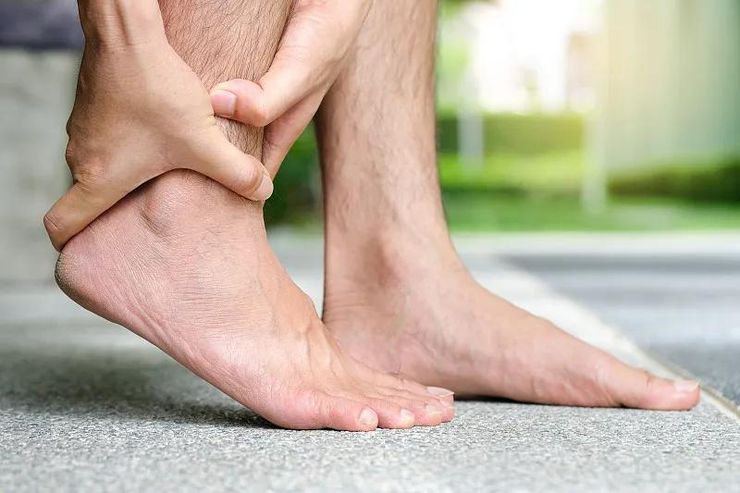
A sprain usually has an incident. You rolled the foot on a curb, landed badly at the gym, or stepped off a curb wrong. Pain and swelling build over the hours after that injury, and they tend to center on the outer side of the ankle where the ligaments tore. Gout has no incident at all. It materializes out of nowhere, very often overnight, and the pain climbs frighteningly fast, typically peaking within 12 to 24 hours. People describe waking at 2 or 3 in the morning with a joint that feels crushed. The swelling wraps around the joint itself rather than sitting over one ligament, and the skin can turn deep red or purple and shiny. A sheet resting on it is unbearable, which is not something a sprain usually does.
One quirk trips a lot of people up: a blood test during the attack can come back showing normal uric acid. That does not rule gout out. Uric acid often dips during an acute flare as crystals rush out of the blood and into the joint. We covered this in more detail in the piece on why your uric acid test can look normal while your toe screams gout. Do not let a “normal” result talk you out of getting the joint looked at.
What else could a hot swollen ankle be?
A few things, and two of them matter more than people think.
The first is a joint infection, septic arthritis. Fever, chills, or feeling genuinely ill on top of a red-hot joint means treating it as an infection until proven otherwise, even if you have had gout before. Gout does not make you immune. The practical signs are in this breakdown of when gout fever is really a joint infection. The second is pseudogout, calcium pyrophosphate crystals. It behaves almost exactly like gout but mostly hits knees and wrists in older adults. Both can put out a fever, which is why a hot joint that does not fit your usual pattern deserves a same-day visit rather than a guess.
Further down the list are a reactive arthritis, a flare of rheumatoid arthritis, and cellulitis, a skin infection rather than a joint one. With cellulitis the redness tends to spread across the skin with an advancing edge, and the joint itself still moves.
What do I do in the first 24 hours?
The medicines that work are the same wherever the flare sits: a low dose of colchicine, an NSAID such as naproxen or indomethacin, or a corticosteroid. The catch is that the right choice depends on your kidneys, your stomach, your heart, and the other pills in your cabinet, so starting early through a clinician or an established flare plan beats raiding the medicine chest.
Colchicine is the classic example of why more is not better. The big multicenter trial that settled the question enrolled 184 people with early flares. Low-dose colchicine, 1.8 mg total over the first hour, produced at least 50% pain relief at 24 hours in 37.8% of people versus 15.5% on placebo. The old high-dose approach, 4.8 mg over six hours, worked no better, but 76.9% of those taking it ended up with diarrhea. The low-dose group’s side effects were statistically indistinguishable from placebo. So if you have been prescribed colchicine, take it as written, and do not double up because “it is just a plant medicine.” Also know that colchicine has a genuinely dangerous interaction with the common antibiotic clarithromycin, worth knowing before any prescriber hands you both.
When an NSAID is off the table because of kidney problems, ulcers, blood thinners, or heart disease, steroids do the same job. A meta-analysis of three double-blind randomized trials covering 584 people found oral prednisolone, 30 to 35 mg a day, produced pain relief comparable to naproxen or indomethacin, with fewer people dropping out over stomach side effects. The step-by-step moves for the first half-day are laid out here: what to do in the first 12 hours of a gout flare.
While you arrange treatment, rest the joint, elevate the foot above heart level when you can, and use a cold pack wrapped in cloth for short intervals. Do not soak it in a hot bath, and do not try to walk it off. We covered why heat is the wrong move in the ice versus heat question, and whether limping around helps in the guide to walking or resting during a flare.
How is ankle gout actually confirmed?

The reference standard has not changed: a doctor draws a small amount of fluid from the swollen joint with a needle, numbing the area first, and looks at it under a polarized microscope. Uric acid crystals are needle-shaped and negatively birefringent. Pseudogout crystals are rhomboid-shaped and weakly positive. Seeing the crystals settles it on the spot, and the same sample goes for a Gram stain and culture so infection is excluded at the same time. That is why aspiration is not optional when the picture is unclear.
When aspiration is hard, or the diagnosis stays in doubt, imaging carries a lot of weight. Ultrasound shows the double-contour sign, a bright line of urate coating the joint cartilage. A pooled analysis of 13 studies found the sign had person-based sensitivity of 66% and specificity of 92%; looking at all the ultrasound signs together lifted sensitivity to 80% while holding specificity at 83%. Dual-energy CT color-codes urate deposits directly. A systematic review of 10 studies found pooled person-based sensitivity of 81% and specificity of 91% in established gout, but sensitivity fell to 55% when disease duration was under six weeks, so a negative scan very early on cannot fully exclude it. The 2015 ACR and EULAR classification criteria, which bundle these clinical, lab, and imaging features together, performed at 92% sensitivity and 89% specificity in validation.
The pain went but my ankle is still swollen. Normal?
Very. The sharp pain is the immune reaction at full volume, and that stands down before the joint lining and the surrounding soft tissue fully calm down. The ankle bears your whole body weight, so walking on it while it is still irritated keeps low-level swelling going for days, sometimes a week or two longer. You may also notice the skin itch or peel as all that fluid gets reabsorbed, and the joint can feel weak or unsteady for a few weeks. Do not mistake “I can walk again” for “the joint is fully repaired.” High-impact exercise can wait.
What the end of a flare does not do is remove the underlying deposits. The crystals are still in and around the joint, waiting. That is why people who keep attacking get put on daily urate-lowering treatment, usually allopurinol first, with the dose raised until repeat blood tests show uric acid under 6 mg/dL. The ACR guideline strongly recommends this approach for frequent flares, defined as two or more a year, tophi, or gout-related bone damage, and it strongly recommends anti-inflammatory cover for the first three to six months, because lowering uric acid can itself stir up a flare as crystals shift. Diet and alcohol reduction help, but they typically move uric acid only about 1 to 2 mg/dL, which is why medication does the heavy lifting for most people.
Give lingering swelling about ten days to two weeks to settle. Persistent swelling beyond that, swelling that gets worse again, or any return of fever and chills means another look, not another week of waiting.
Frequently asked questions
Can gout be in your ankle without touching your big toe?
Absolutely. The ankle is a classic site, and a first flare can start there. Do not dismiss the diagnosis just because your toe feels fine.
How long does an ankle gout flare last?
Untreated, most flares run about one to two weeks. Treatment started early usually shortens that. Some residual puffiness and stiffness can linger for another week or two after the sharp pain is gone.
Should I walk on an ankle with gout?
Rest and elevate it during the worst of it. Walking on an inflamed ankle worsens swelling and can irritate the tendons around the joint. Gentle movement comes back as the flare settles, not by forcing through pain.
Can a normal uric acid result still be gout?
Yes. Serum uric acid often drops during an acute flare. Joint fluid analysis, ultrasound, or dual-energy CT can confirm what a single blood test cannot.
When is a swollen ankle an emergency?
Get urgent care for fever and chills, a joint that is hot and red with you feeling systemically unwell, severe pain untouched by over-the-counter medicine, or a hot swollen prosthetic joint. Infection must be ruled out quickly.
References
- Chen-Xu M, Yokose C, Rai SK, Pillinger MH, Choi HK. Contemporary Prevalence of Gout and Hyperuricemia in the United States and Decadal Trends: The National Health and Nutrition Examination Survey, 2007-2016. Arthritis Rheumatol. 2019;71(6):991-999. doi:10.1002/art.40807. PMID: 30618180.
- FitzGerald JD, Dalbeth N, Mikuls T, et al. 2020 American College of Rheumatology Guideline for the Management of Gout. Arthritis Care Res (Hoboken). 2020;72(6):744-760. doi:10.1002/acr.24180. PMID: 32391934.
- Neogi T, Jansen TLTA, Dalbeth N, et al. 2015 Gout Classification Criteria: an American College of Rheumatology/European League Against Rheumatism collaborative initiative. Arthritis Rheumatol. 2015;67(10):2557-2568. doi:10.1002/art.39254. PMID: 26352873.
- Gamala M, Jacobs JWG, van Laar JM. The diagnostic performance of dual energy CT for diagnosing gout: a systematic literature review and meta-analysis. Rheumatology (Oxford). 2019;58(12):2117-2121. doi:10.1093/rheumatology/kez180. PMID: 31089688.
- Zhang Q, Gao F, Sun W, Ma J, Cheng L, Li Z. The diagnostic performance of musculoskeletal ultrasound in gout: a systematic review and meta-analysis. PLoS One. 2018;13(7):e0199672. doi:10.1371/journal.pone.0199672. PMID: 29979706.
- Terkeltaub RA, Furst DE, Bennett K, Kook KA, Crockett RS, Davis MW. High versus low dosing of oral colchicine for early acute gout flare: twenty-four-hour outcome of the first multicenter, randomized, double-blind, placebo-controlled, parallel-group, dose-comparison colchicine study. Arthritis Rheum. 2010;62(4):1060-1068. doi:10.1002/art.27327. PMID: 20131255.
- Yu J, Lu H, Zhou J, Xie Z, Wen C, Xu Z. Oral prednisolone versus non-steroidal anti-inflammatory drugs in the treatment of acute gout: a meta-analysis of randomized controlled trials. Inflammopharmacology. 2018;26(3):717-723. doi:10.1007/s10787-018-0442-8. PMID: 29357007.
- Dalbeth N, Kalluru R, Aati O, Horne A, Doyle AJ, McQueen FM. Tendon involvement in the feet of patients with gout: a dual-energy CT study. Ann Rheum Dis. 2013;72(9):1545-1548. doi:10.1136/annrheumdis-2012-202786. PMID: 23334212.
- Newberry SJ, FitzGerald JD, Motala A, et al. Diagnosis of Gout: A Systematic Review in Support of an American College of Physicians Clinical Practice Guideline. Ann Intern Med. 2017;166(1):27-36. doi:10.7326/M16-0462. PMID: 27802505.
Reviewed by the GoutSavvy Editorial Team