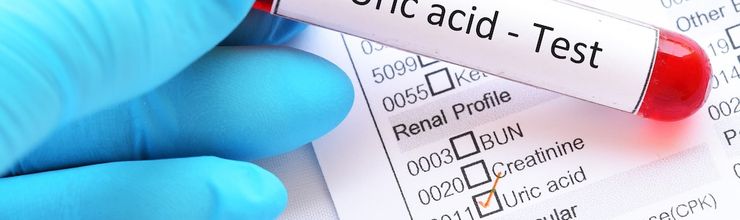
Your uric acid is 8.2. Your friend’s is 8.0. You’ve never had a gout attack. They’ve had six.
For decades, doctors couldn’t explain this gap. High uric acid was supposed to be the whole story. The higher your levels, the more likely you’d get gout, right?
Not exactly. About 21% of adults have elevated uric acid, but only around 4% actually develop gout. That gap between “high uric acid” and “real gout” has been one of the biggest unanswered questions in rheumatology.
Now researchers at the University of California San Diego think they’ve found the missing piece. It’s a protein called lubricin, and it might explain why your joints fight off crystals while someone else’s don’t.
The Uric Acid Paradox That Stumped Doctors
Here’s the puzzle. High uric acid (a condition called hyperuricemia) drives crystal formation. That part is well established. Uric acid builds up in your blood, saturates your joint fluid, and forms needle-shaped monosodium urate crystals. Those crystals trigger the NLRP3 inflammasome, a protein complex in your immune cells that fires off inflammatory signals. The result is the redness, swelling, and pain you feel during a flare.
But most people with high uric acid never develop those crystals. Asymptomatic hyperuricemia is roughly 4 to 5 times more common than gout. Millions of people walk around with uric acid above 7 mg/dL and never have a single attack.
If uric acid alone determined whether crystals formed, this shouldn’t happen.
Dr. Robert Terkeltaub, a rheumatologist at UC San Diego and the VA San Diego Healthcare System, decided to find out what else was going on. His team’s findings, published in Arthritis and Rheumatology, point to a protein most people have never heard of.
The Patient Who Shouldn’t Have Had Gout
The research started with a 22-year-old woman who broke every rule in the textbook.
She had gout. Real, biopsy-confirmed gout, with urate crystal deposits in her joints, bursae, tendons, and ear cartilage. Her joints showed erosion, the kind of structural damage you see in advanced disease.
But her blood uric acid was normal.
By the current model, that shouldn’t be possible. You need elevated uric acid to saturate joint fluid and drive crystallization. Without high blood uric acid, where were the crystals coming from?
The team ran whole genome sequencing, quantitative proteomics, and RNA sequencing on this patient. They compared her biology to her parents and to healthy controls.
What they found was that a protein called lubricin was almost absent from her joint fluid.
What Lubricin Does (And Why Your Joints Need It)
Lubricin, also called proteoglycan 4 or PRG4, is produced by cells in your joint lining (synovial fibroblasts) and the surface layer of your cartilage. Think of it as the oil in your car’s engine. It coats the cartilage surface, reduces friction between moving parts, and keeps everything gliding smoothly.
But lubricin does more than lubricate. The UC San Diego team found it has three jobs that directly affect whether you get gout:
First, it blocks uric acid crystals from forming in your joint fluid. In lab experiments, lubricin at concentrations found in healthy joints (around 200 micrograms per milliliter) prevented urate crystallization. When lubricin drops, crystals form more easily.
Second, it suppresses local uric acid production inside the joint. When immune cells called macrophages get activated by inflammation, they produce xanthine oxidase, the same enzyme that creates uric acid in your body. Lubricin puts the brakes on that process. Without enough lubricin, your joint starts manufacturing its own uric acid, separate from what’s circulating in your blood.
Third, it calms the immune response to any crystals that do sneak through. Lubricin binds to a receptor on macrophages called CD44, limiting how many urate crystals these immune cells swallow. Less crystal uptake means less inflammasome activation and less of that explosive inflammation you feel during a flare.
When lubricin levels are healthy, your joints have a built-in defense system. When lubricin drops, all three layers of protection fail at once.
What Drains Your Lubricin Supply?
The researchers identified several pathways that can tank your lubricin levels:
Genetics play a role. The young patient had damaging gene variants in NLRP3 (the same inflammatory pathway that drives gout flares) and in a gene called ITIH3. ITIH3 normally blocks an enzyme called Cathepsin G, which chews up lubricin. When the genetic brake on Cathepsin G fails, it destroys lubricin faster than your body can replace it. This aligns with what we already know about genetics and gout risk.
Inflammation itself creates a vicious cycle. When a receptor called TLR2 gets activated by inflammation, it actively shuts down lubricin production in joint lining cells. So gout inflammation suppresses lubricin, low lubricin allows more crystals to form, more crystals trigger more inflammation, and the whole thing spirals.
Age and joint wear matter too. Lubricin naturally decreases in osteoarthritis, and the researchers noted that gout and osteoarthritis frequently coexist in the same joints. Low lubricin could be one reason why.
It Wasn’t Just This One Patient
Here’s what makes this more than a rare case study.
When the team examined joint fluid from 18 people with typical gout and elevated uric acid, they found reduced lubricin levels there too. Five of those 18 had notably low levels.
That means lubricin deficiency isn’t some freak occurrence. It appears to be a common feature of gout, even in people whose uric acid is well above normal.
This could explain why two people with nearly identical uric acid levels can have completely different experiences. One person has healthy lubricin and their joints hold the line. The other has genetically low lubricin or inflammation-driven lubricin loss, and their joint becomes a crystal factory.
What This Means for You Right Now
Let’s be clear about one thing: this research doesn’t change what you should be doing today.
If you’re on allopurinol, febuxostat, or dotinurad, keep taking it. Urate-lowering therapy (ULT) remains the foundation of gout management. Nothing in the lubricin research suggests you should stop or switch medications. If anything, it reinforces why getting your uric acid to target matters: lower uric acid means less stress on whatever lubricin you do have.
But this discovery does raise some questions that might affect you sooner than you think.
Could lubricin become a predictive test? If researchers can develop a reliable blood or joint fluid test for lubricin levels, doctors might be able to tell which people with high uric acid will actually develop gout. That could save a lot of people from unnecessary worry while flagging those who need early intervention. Given what we know about kidney function and gout, a lubricin test could add another layer to risk assessment.
Could lubricin-based treatments work? Recombinant lubricin (rhPRG4) already exists and has been tested in osteoarthritis models. In lab studies, it showed dose-dependent inhibition of interleukin-1 beta (IL-1 beta), tumor necrosis factor alpha (TNF-alpha), and interleukin-8 (IL-8), the same inflammatory molecules that drive gout attacks. It even blocked NLRP3 inflammasome assembly. Clinical trials for gout are a reasonable next step.
For now, though, there’s no lubricin pill or injection you can ask your doctor for. The science is still in the lab and early clinical stages.
Can You Protect Your Lubricin Naturally?
No supplement or food has been proven to boost lubricin levels in humans. If a product claims to do this, it’s making things up.
That said, a few things align with what we know about lubricin biology:
Regular, moderate exercise stimulates synovial fluid circulation, which helps distribute lubricin across your joint surfaces. A 2019 study found that moderate exercise increased PRG4 expression in joint tissue. The key word is moderate. Overdoing it can trigger flares, especially if you’re not used to the activity.
Omega-3 fatty acids may reduce synovial inflammation, which could indirectly protect lubricin by calming the TLR2-driven suppression that shuts down its production.
Weight management matters. Obesity is associated with both low-grade inflammation and increased gout risk. Losing excess weight reduces systemic inflammation, which could help preserve lubricin production.
But these are common-sense joint health practices that happen to align with lubricin biology. None of them are proven lubricin boosters.
What’s Coming Next
The big picture is this: we’re moving from a one-dimensional model of gout (high uric acid equals crystals equals pain) to a model where joint health, immune regulation, and local protein levels all matter. Your uric acid number is still important, but it’s not the whole story.
The gout treatment pipeline is accelerating. As of August 2026, over 25 pharmaceutical companies are developing new gout drugs, according to a report by DelveInsight. Several research groups are exploring recombinant lubricin as a potential therapy. The connection between lubricin and the NLRP3 inflammasome, the same pathway that drives your flares, makes this protein a promising target.
If you’ve been confused about why your gout doesn’t follow the textbook pattern, or why your uric acid is high but you’ve never had a flare, lubricin might be the missing piece. It’s still early, but this discovery could eventually change how doctors predict who develops gout and how they treat it.
Frequently Asked Questions
Can I get my lubricin levels tested?
Not yet in routine clinical practice. Lubricin testing is currently used in research settings only. If this discovery leads to clinical applications, a blood or joint fluid test could become available in the coming years.
Does low lubricin mean I’ll get gout for sure?
No. Low lubricin appears to increase susceptibility to crystal formation, but it’s one factor among many. Your overall uric acid level, kidney function, genetics, and other risk factors all play a role. Plenty of people with lower-than-average lubricin may never develop gout.
Should I change my gout medication because of this research?
No. This research doesn’t change current treatment guidelines. Urate-lowering therapy remains the most effective way to prevent gout attacks and protect your joints. If you have questions about your specific situation, talk to your rheumatologist.
Is there a supplement that increases lubricin?
No supplement has been proven to increase lubricin in humans. Some companies may try to sell products claiming to boost lubricin, but there’s no clinical evidence supporting these claims. Focus on proven gout management: medication adherence, hydration, and dietary modifications.
If my uric acid is high but I’ve never had gout, should I start medication?
Current guidelines generally recommend against starting urate-lowering therapy for asymptomatic hyperuricemia. However, if you have other risk factors like kidney disease, cardiovascular disease, or a strong family history of gout, your doctor might consider it. This is a conversation to have with your healthcare provider.
Will there be a lubricin-based gout treatment?
It’s possible but not certain. Recombinant lubricin exists and shows promise in lab studies, but moving from lab to clinic takes years of testing for safety and effectiveness. The research is encouraging, but it will take time before any treatment reaches patients.
References
- Elsaid K, Merriman TR, Rossitto LA, Liu-Bryan R, Karsh J, Phipps-Green A, et al. “Amplification of inflammation by lubricin deficiency implicated in incident, erosive gout independent of hyperuricemia.” Arthritis and Rheumatology. 2022;74(12):1879-1890. doi:10.1002/art.42413. PMID: 36457235.
- Reginato AM, Sun C, Khaled EA, Schmidt TA, Liang OD, Jay GD. “Lubricin/Proteoglycan 4 (PRG4) Inhibits NLRP3 Inflammasome Assembly in Monosodium Urate (MSU)-Crystal Induced Arthritis.” Arthritis and Rheumatology. 2018;70(suppl 9). Abstract 2245.
- Reginato AM, Qadri M, Sun C, Schmidt T, Yang N, Elsaid K, Jay G. “Anti-Inflammatory Role of Lubricin/Proteoglycan 4 (PRG4) in Monosodium Urate (MSU)-Crystal Induced Arthritis.” Arthritis and Rheumatology. 2016;68(suppl 10). Abstract 2260.
- Elsaid K, et al. “Proteoglycan 4 (PRG4)/Lubricin and the Extracellular Matrix in Gout.” Gout, Urate, and Crystal Deposition Diseases. 2023;1(3):122-136. doi:10.3390/gucdd1030012.
- University of California San Diego. “A hidden joint problem may cause gout.” Science news coverage, August 2026.
- DelveInsight. “Gout Pipeline Insight 2026.” Pharmaceutical industry report, August 2026.
- Choi HK, Niu J, et al. “Nocturnal risk of gout attacks.” Arthritis and Rheumatology. 2015;67(2):555-562.
Reviewed by the GoutSavvy Editorial Team