
It’s day 3. The worst of the fire is out, but your big toe is still swollen, warm, and tender enough that a dropped sock hurts. You’ve missed work, slept in a chair, and asked the ceiling the same question over and over: how long does this actually last?
Nobody at the pharmacy tells you. The pamphlet says “acute attacks” and stops there. So here’s what actually happens, hour by hour and day by day, and the mistake most people make right when they start feeling better.
Here’s the Honest Answer First
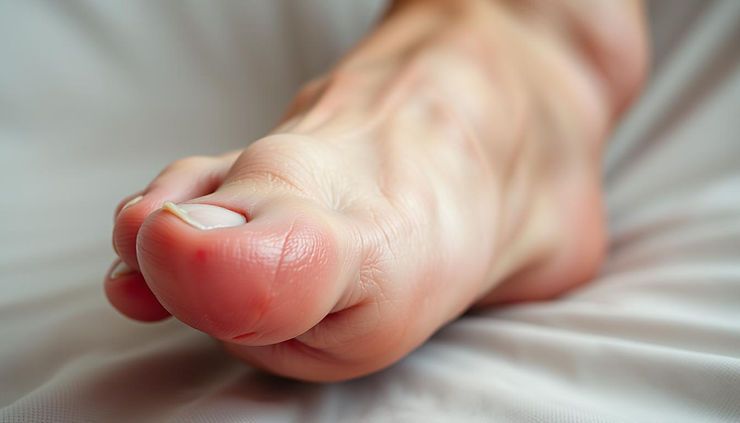
Treated properly, most flares start backing off within 24 to 72 hours and fully clear within a few days to two weeks [1,3]. Left untreated, the typical flare burns out on its own in about 7 to 10 days, though some drag on for two or even three weeks [1].
First flare? It’s often the mildest. Many people ride out a first attack in 3 to 7 days and assume it was a one-off sprain or a bad shoe. Then it comes back. Without treatment that lowers uric acid, roughly 62% of people get a second flare within a year, and about 78% within two years [5]. Each round tends to arrive faster, hit harder, and last longer than the one before.
So the real answer to “how long will this last” has two layers: how long this flare runs, and how long you’ll keep getting flares if nothing changes. Those are different problems with different fixes.
Day by Day: What a Typical Flare Looks Like
Flares follow a rough script. Yours may run faster or slower, but the shape is usually the same.
Hours 0 to 12: It usually starts at night, often between 2 and 4 a.m. You wake up because your toe feels like it’s trapped in a vice, or the bedsheet itself is unbearable. Swelling, redness, and heat ramp up fast. This is when treatment works best, and it’s exactly what we covered in Your Gout Flare Started 2 Hours Ago: What to Do in the First 12 Hours [2,3].
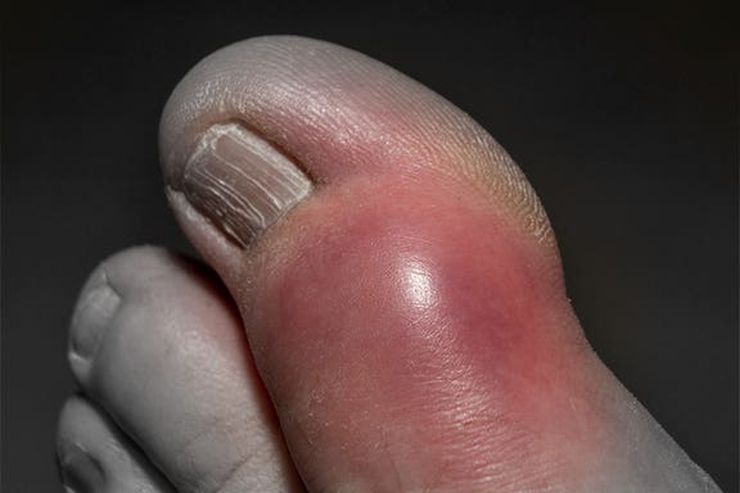
Day 1 to 2: The peak. The joint is hot, shiny, and exquisitely tender. Walking is optional at best. This is also when people start bargaining with the universe. Push through it if you want, but the clock is running either way.
Day 3 to 5: The turning point for most people. The throbbing dulls to an ache. The swelling starts to drain, though the skin over the joint may still look bruised and feel tight. If you started medication early, you probably crossed this bridge a day or two sooner [4].
Day 5 to 10: You’re walking mostly normally, maybe with a slight favor to the good side. The joint is stiff but not angry. Many people stop all treatment here because it “feels done.”
Day 7 to 14: The quiet ending. One detail almost nobody mentions: as the flare finishes, the skin over the joint often gets itchy and peels, like a mild sunburn. It looks alarming and it isn’t. It’s a standard healing pattern after heavy inflammation in a small joint.
After 2 weeks: Everything looks normal. The pain is gone. The joint works. It is tempting to file this away as “that thing I ate.” Keep reading, because this is exactly where the trap is.
Why Some Flares End in 3 Days (and Others Drag On for Weeks)
Two people can get the same kind of flare and have wildly different timelines. A few things decide yours.
When you started treatment. This is the big one. Medication started within the first 24 hours cuts the trip short; the same medication started on day 4 works against a fire that has already spread [2,3]. Infection, no, but inflammation recruits more inflammation, and every hour makes it more crowded in there.
How many joints are involved. A single cranky big toe usually resolves faster than a flare that hits your foot, ankle, and knee at once. Multi-joint flares tend to run longer and hit harder, and they’re more common the longer someone has gone without uric acid control [3].
How long uric acid has been high. Crystals accumulate silently for years before the first flare. The bigger that hidden deposit, the more fuel each flare has, and the slower it clears. This is why the tenth flare rarely behaves like the first.
Whether you just started urate-lowering medication. Starting allopurinol or febuxostat can temporarily stir up flares during the first few months, because shrinking crystal deposits can shake them loose [3]. That’s not the drug failing. Stopping the drug over it usually makes the whole marathon longer. More on that below.
Where your uric acid level sits. Flares get easier to trigger and slower to quiet down when uric acid stays well above the saturation point of about 6.8 mg/dL [1].
The 24-Hour Window That Changes Everything
If you take one actionable thing from this article, take this: the clock starts at the first twinge, not at the moment the pain becomes undeniable.
European guidelines recommend starting treatment within 24 hours of a flare starting, and getting a clear written plan from your doctor so you’re not guessing at midnight [2]. The American College of Rheumatology says the same thing in its own way: treat early, because delaying makes the flare worse and longer [3].
The evidence for moving fast is solid. In a randomized trial of 575 people caught within 12 hours of flare onset, a low-dose colchicine regimen (1.2 mg, then 0.6 mg an hour later) produced at least 50% pain relief within 24 hours in 37.8% of people, versus 17.5% on placebo [4]. Same drug, same dose cap, but the people who took it early spent less time in pain than those who wait and hope.
This is why a lot of doctors now hand people with frequent flares a “just in case” prescription, sometimes called pill-in-the-pocket, along with instructions for exactly when to take it. If your flares come at night (most do), having the plan in your kitchen drawer beats calling a pharmacy at 3 a.m. We broke down that approach in Do You Really Need a Daily Pill to Prevent Gout Flares When Starting Allopurinol?
When Is It Really Over? Don’t Trust the Pain
Here’s the part most people get wrong, and it costs them years.
Pain stopping is not the same as the problem leaving. In a study of people whose flares had fully quieted down, researchers pulled fluid from their symptom-free joints and still found urate crystals floating in most of them, along with signs of low-grade inflammation [6]. The joint looked calm. It wasn’t calm. The crystals were just waiting.
That’s the mechanism behind the relapse numbers. The flare ends because the acute inflammation burns down, not because the urate load is gone. If your uric acid stays high, the deposit stays, and the next flare is a matter of time, not chance. Roughly 62% get hit again within a year [5]. Meanwhile the same silent process keeps working between flares, which we covered in Gout Damage Between Flares: The Silent Progression.
There’s a practical twist too: testing uric acid during a flare can be misleading, because levels often dip temporarily while the inflammation is at full blast. That’s why the sensible move is to test about two weeks after everything calms down. We explain the full picture in Your Uric Acid Test Says Normal. Your Toe Says Gout.
So when is a flare “really” over? The pain tells you the acute part is over. Your uric acid level, checked at the right time, tells you whether the whole story is over. Only the second one predicts the future.
How to Make Your Next Flare Shorter
You can’t un-start this flare, but you can absolutely change the next one. In order of what actually moves the needle:
1. Keep taking your urate-lowering medication, even mid-flare. Guidelines are blunt on this: a flare is not a reason to stop allopurinol or febuxostat [3]. Stopping resets the clock on the slow process of dissolving crystals. If you want to know what happens when people quit, we looked at the biggest study on stopping in Can You Stop Gout Medication? The Largest Study So Far.
2. Ride out the first few months on a preventive. Low-dose colchicine (or an NSAID, when your kidneys and stomach allow) during the first 3 to 6 months of urate-lowering therapy is standard, precisely because those early months are flare-prone [3]. It tapers off once the crystal burden shrinks.
3. Aim your uric acid at the target, not at “normal-ish.” Crystals start dissolving when uric acid drops below about 6 mg/dL, and faster below 5 if you have visible lumps [2,3]. Every point of control buys you shorter flares and longer gaps between them. Anti-inflammatory drugs treat the fire; only low uric acid removes the fuel.
4. Treat every flare as data. Note what preceded it, how long it lasted, and what you took and when. Patterns show up fast, and they make the conversation with your doctor a lot more useful than “it happened again.”
NSAIDs and colchicine both work for the acute part, though the evidence base for how well they shorten flares is thinner than most people assume; a Cochrane review found fewer high-quality trials than you’d expect for such a common problem [7]. What’s not thin: starting early beats starting late [2,4].
Common Questions
How long does a gout flare last without any treatment?
Most untreated flares settle in about 7 to 10 days, with improvement usually starting after 3 or 4 days. Some run two to three weeks, especially flares involving more than one joint [1,3]. Treating early typically shaves days off that timeline [2,4].
Can a gout flare really be over in one day?
A mild first flare can fade within 24 to 48 hours, especially with early medication. But a one-day flare with a rapid recovery is also a classic pattern for the very first warning shot. If your toe has ever flared once, even briefly, it’s worth getting your uric acid checked rather than waiting for round two.
Why is the skin on my toe peeling after the flare?
Peeling and itching as the swelling goes down is a normal late-stage feature of flares, similar to how skin peels after a sunburn. The intense inflammation of a small joint damages the outer skin layer. If the skin looks broken, hot, and the redness is spreading with fever, that’s a different problem and needs a doctor, because infection and gout can look alike.
Should I stop allopurinol while I’m having a flare?
No. Guidelines are clear that flares during urate-lowering therapy are managed with anti-inflammatory treatment, not by stopping the urate-lowering drug [3]. Stopping lets uric acid climb back up and prolongs the whole project. If your flares continue on a stable dose, that’s a dose-adjustment conversation, not a DIY exit.
How long after a flare should I test my uric acid?
About two weeks after the flare fully resolves. During the flare itself, uric acid often reads artificially low, which is how people get a “normal” number and a swollen toe at the same time [1].
When should I call a doctor during a flare?
Right away if this is your first flare and nothing is confirmed yet, since other conditions can mimic gout. Also if a treated flare shows no improvement after 3 or 4 days, if several joints swell at once, if you have fever or chills, or if you can’t take standard medications because of kidney, stomach, or heart problems [2,3].
References
- Neogi T. Clinical practice. Gout. N Engl J Med. 2011;364(5):443-452. doi:10.1056/NEJMcp1001124. PMID: 21288096.
- Richette P, Doherty M, Pascual E, et al. 2016 updated EULAR evidence-based recommendations for the management of gout. Ann Rheum Dis. 2017;76(1):29-42. doi:10.1136/annrheumdis-2016-209707. PMID: 27457514.
- FitzGerald JD, Dalbeth N, Mikuls T, et al. 2020 American College of Rheumatology Guideline for the Management of Gout. Arthritis Care Res (Hoboken). 2020;72(6):744-760. doi:10.1002/acr.24180. PMID: 32391934.
- Terkeltaub RA, Furst DE, Bennett K, Kook KA, Crockett RS, Davis MW. High versus low dosing of oral colchicine for early acute gout flare: Twenty-four-hour outcome of the first multicenter, randomized, double-blind, placebo-controlled, parallel-group, dose-comparison colchicine study. Arthritis Rheum. 2010;62(4):1060-1068. doi:10.1002/art.27326. PMID: 20131255.
- Rott KT, Agudelo CA. Gout. JAMA. 2003;289(21):2857-2860. doi:10.1001/jama.289.21.2857. PMID: 12783917.
- Pascual E. Persistence of monosodium urate crystals and low-grade inflammation in the synovial fluid of patients with untreated gout. Arthritis Rheum. 1991;34(2):141-145. doi:10.1002/art.1780340203. PMID: 1994910.
- van Durme CM, Wechalekar MD, Landewe RB. Non-steroidal anti-inflammatory drugs for acute gout. Cochrane Database Syst Rev. 2021;12:CD010120. doi:10.1002/14651858.CD010120.pub3. PMID: 34882311.
Reviewed by the GoutSavvy Editorial Team