
Only 1 in 3 People With Gout Take Their Medication. Here’s Why That’s a Crisis.
If you have high blood pressure, there’s a roughly 70% chance you take your pills every day. Diabetes? About 65%. Osteoporosis? Around 55%.
Gout? Thirty-seven percent.
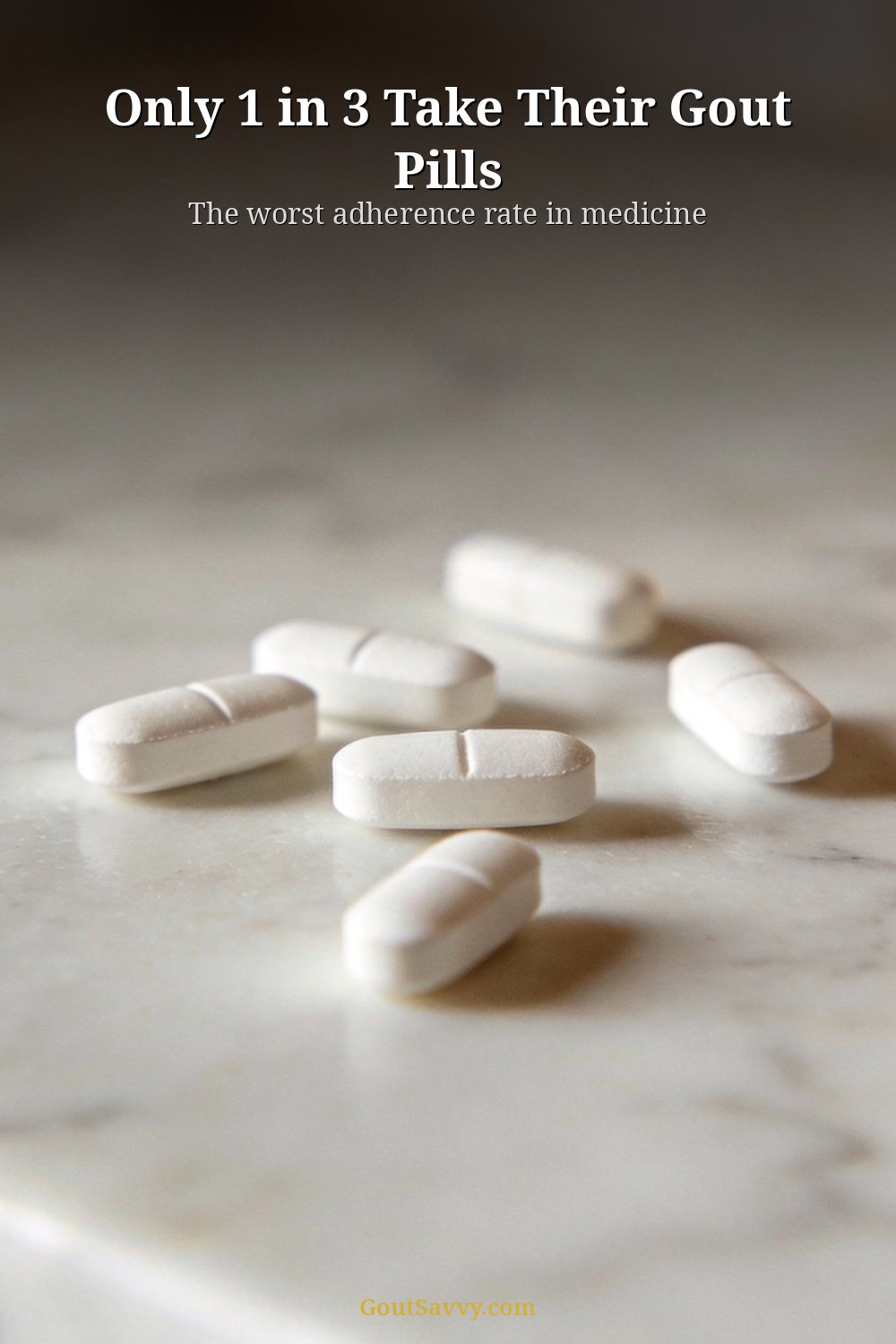
That’s not a typo. According to data presented at the RheumNow Gout Campaign in July 2026, gout has the worst medication adherence rate of any common chronic disease. Only about 1 in 3 people prescribed urate-lowering therapy actually take it consistently. The rest stop, skip doses, or skip filling their prescription in the first place.
And that matters. Because gout is one of the few forms of arthritis where the underlying cause can be eliminated. You can dissolve the crystals, stop the flares, and protect your joints and kidneys. But only if you take the medication.
So why don’t people do it? The answer is more complicated than “they just don’t care.”
The Real Reasons People Quit
A UK study published in Rheumatology Advances in Practice surveyed 634 adults with gout about why they stopped their urate-lowering medication. The top reasons weren’t what you might expect.
Side effects came first, cited by about 30% of those who quit. Rash, stomach upset, or just feeling “off” after starting allopurinol. Some of these are real. Some are the body adjusting. But when your doctor hands you a pill and you feel worse, the natural response is to stop.
“Fed up with taking tablets” came in second, at about 20%. This one hits hard if you’ve ever been on long-term medication. The daily reminder that you’re sick. The pill organizer on the kitchen counter. The pharmacy runs. For people whose gout flares come and go, it’s easy to think, “I feel fine right now, why do I need this?”
No perceived benefit was the third reason, also around 20%. And this one reveals a fundamental communication problem. Urate-lowering therapy doesn’t make you feel better immediately. It’s not a painkiller. It’s more like cholesterol medication, you don’t feel it working, but it’s quietly dissolving crystals and preventing future attacks. If nobody explains this, of course people quit.
Here’s the kicker: about 16% of people said their doctor stopped the medication without explaining why. So it’s not just the patient’s choice. Sometimes the healthcare system itself gives up on gout treatment.
The Paradox That Traps Everyone
Here’s something that catches almost everyone off guard. When you start allopurinol (or febuxostat, or any urate-lowering drug), your serum urate drops. That sounds good. But rapid drops in uric acid can trigger gout flares during the first few months.
So you start taking a pill to prevent gout attacks, and what happens? You get a gout attack. The medication seems like it’s making things worse.
This is the single most common reason people abandon treatment within the first six months. They’re not irrational. They’re experiencing more pain after starting a pill that was supposed to prevent pain. Without proper education about why this happens and how to manage it (typically with colchicine or NSAIDs during the initiation period), stopping feels like the only logical choice.
If you’re struggling with flares after starting treatment, you’re not alone. Our guide on stopping a gout attack fast covers what actually works during these initiation flares.
Doctors Are Part of the Problem Too
It’s not just patients. The medical system shares plenty of blame.
A landmark study called LASSO (Long-term Allopurinol Safety Study Evaluating Outcomes in Gout) found something embarrassing. Even in a clinical trial setting where doctors were encouraged to titrate allopurinol doses, 65% of participants were stuck at 300 mg daily or less. Only 20% got doses above 300 mg. And guess what? At 300 mg, only about 22% of people reached their target serum urate level.
In other words, the standard allopurinol dose that most doctors prescribe doesn’t work for most people. The dose needs to be gradually increased until your uric acid hits the target (below 6.0 mg/dL for most, below 5.0 mg/dL if you have tophi). But many doctors rarely titrate up. They prescribe 300 mg, check once, and move on.
A UK nurse-led trial showed the difference clearly. When specially trained nurses managed gout care, including education, shared decision-making, and aggressive dose titration, the mean allopurinol dose was 460 mg daily. When general practitioners handled it, the mean dose was 230 mg. Half the dose. And the results? 95% of nurse-led patients hit their urate target, compared to just 30% under usual care.
That’s not a small gap. That’s the difference between controlled disease and progressive joint damage.
What Happens When You Don’t Take Your Medication
Maybe you’re thinking, “So I skip some pills. What’s the worst that could happen?”
A meta-analysis of 131 studies covering 3.4 million people found that hyperuricemia is associated with a higher risk of rapid kidney function decline, chronic kidney disease, and kidney failure. The relationship between gout and kidney disease runs both ways. High uric acid damages the kidneys. Damaged kidneys can’t filter uric acid. It’s a vicious cycle.
Then there’s the joint damage. Without treatment, gout progresses from occasional flares to chronic pain, joint deformity, and tophi (hard lumps of urate crystals under the skin). The risk of a second gout attack after the first is 62% within one year, 78% within two years, and 93% within ten years. Without urate-lowering therapy, the question isn’t if you’ll have another attack. It’s when, and how bad.
There’s also the cardiovascular risk. People with uncontrolled gout have higher rates of heart attacks and strokes. The inflammation from recurrent flares doesn’t just stay in your toe. It affects your whole body.
What Actually Works
The good news? This problem has solutions. They’re just not widely implemented.
Education changes everything. The UK nurse-led trial didn’t use any secret medication or experimental drug. They used the same allopurinol everyone else uses. The difference was that nurses spent time explaining what gout is, why the medication works, what to expect during the first few months, and why it’s important to keep going even when you feel fine. That’s it. And it worked spectacularly.
Treat-to-target matters. Rather than prescribing a fixed dose and hoping for the best, the treat-to-target approach means checking your uric acid regularly and adjusting the dose until you hit your goal. Think of it like adjusting your thermostat. You don’t set it once and walk away. You check, adjust, and fine-tune. If you want to understand what your numbers mean, our guide to uric acid blood test results breaks it down.
Self-monitoring helps. When people can check their own uric acid at home, they can actually see whether the medication is working. That feedback loop is powerful. Instead of taking a pill on faith, you can watch your numbers drop. Research shows that self-monitoring improves adherence because it turns an invisible process into something you can track and celebrate.
Flare prevention during initiation is non-negotiable. If your doctor starts you on urate-lowering therapy without also prescribing colchicine or an NSAID for the first 3 to 6 months, that’s a red flag. The American College of Rheumatology specifically recommends prophylactic anti-inflammatory treatment during initiation to prevent the flares that make people quit.
Practical Steps If You’re Struggling
If you’ve quit your gout medication, or you’re thinking about it, here’s what to do:
Talk to your doctor honestly. Tell them you stopped. Don’t be embarrassed. They’ve heard it before. Ask about side effects, alternative medications, or dose adjustments. If you were on allopurinol and couldn’t tolerate it, febuxostat is an option that works through a similar mechanism.
Ask about flare prophylaxis. If you had flares when you started, ask for colchicine or an NSAID to take alongside your urate-lowering drug during the first few months. This simple step prevents the most common reason for quitting.
Get your uric acid checked. You can’t manage what you don’t measure. If your level is above 6.0 mg/dL, your treatment needs adjustment. Not necessarily a different drug. Maybe just a higher dose.
Give it time. Most people see their flare frequency drop significantly within 6 to 12 months of consistent treatment. Crystal dissolution takes time. The first few months are the hardest. It gets better.
If you’re wondering whether you can ever stop, the largest study on this topic found that stopping medication usually leads to recurrence. Our deep dive on whether you can stop gout medication covers what the research actually shows.
The Bottom Line
Gout has a 37% adherence rate not because people with gout are lazy or careless. It’s because the medical system often fails to explain why the medication matters, doesn’t prevent the flares that make people quit, and under-doses the most common drug. The fix isn’t complicated. Education, flare prevention, proper dosing, and regular monitoring can push adherence above 90%. If you’re one of the two-thirds of people who’ve stopped taking your gout medication, it’s worth giving it another shot. With the right support, gout is one of the few forms of arthritis you can actually control.
Frequently Asked Questions
Why is gout medication adherence so low compared to other diseases?
Several reasons. Gout flares come and go, so people feel fine between attacks and question whether they need daily medication. Starting urate-lowering therapy can trigger flares, making the drug seem like it’s causing the problem. And many doctors don’t explain that gout is a chronic condition requiring lifelong management, or they under-dose the medication.
Will I have to take gout medication forever?
For most people, yes. Urate-lowering therapy works by keeping your serum urate below the crystallization threshold. If you stop, uric acid levels rise again and crystals reform. Some people with very specific, reversible causes of high uric acid (like certain medications or dietary factors) may be able to stop eventually, but this should only be done under medical supervision with regular monitoring.
What should I do if I get a flare after starting allopurinol?
Don’t stop the allopurinol. This is a common and expected reaction. Talk to your doctor about taking colchicine or an NSAID to manage the flare. The flares usually subside within a few months as your body adjusts. Stopping the medication resets the clock and means you’ll go through this phase again when you restart.
How long does it take for urate-lowering therapy to dissolve existing crystals?
Crystal dissolution is gradual. Most people see a significant reduction in flare frequency within 6 to 12 months of reaching their target urate level. Complete dissolution of tophi can take 1 to 3 years. Consistent medication adherence is the single most important factor in how quickly this happens.
Can I manage gout with diet alone instead of medication?
Diet helps, but it rarely lowers uric acid enough on its own. Dietary changes typically reduce serum urate by 1 to 2 mg/dL at most. If your level is significantly elevated, medication is usually necessary. Diet and medication work best together, not as substitutes.
References
1. Edwards NL. “Problems with treatment adherence in the management of gout.” RheumNow Gout Campaign, July 2026.
2. Pelle G, et al. “Management and long-term serum urate control in gout: a population-based primary care cohort study.” British Journal of General Practice, July 2026.
3. Elmelegy D, Abhishek A. “Reasons for discontinuing urate-lowering treatment in community-dwelling adults with gout: results of a primary care-based cross-sectional study.” Rheumatology Advances in Practice, 2021;5(2):rkab022.
4. Doherty M, et al. “Efficacy and cost-effectiveness of nurse-led care involving education and engagement of patients and a treat-to-target urate-lowering strategy versus usual care for gout: a randomised controlled trial.” The Lancet, 2018;392(10156):1403-1412.
5. Sharma G, Dubey A, Nolkha N, Singh JA. “Hyperuricemia, urate-lowering therapy, and kidney outcomes: a systematic review and meta-analysis.” Therapeutic Advances in Musculoskeletal Disease, 2021;13:1759720X2110166.
6. Stamp LK, et al. “Gout and urate-lowering therapy: the LASSO trial.” Journal of Rheumatology, 2017.
7. Menon SG, et al. “Gout.” StatPearls, National Center for Biotechnology Information, updated April 2026.
Reviewed by the GoutSavvy Editorial Team