Your Gout Might Start in Your Sleep
Imagine this: you go to bed feeling fine, then wake up at 3 AM with a big toe that feels like someone hit it with a hammer. Sound familiar?
Most people blame dinner. The steak, the beer, maybe that extra slice of bacon. But what if the real trigger happened while you were unconscious?
Research from Harvard found that people with obstructive sleep apnea (OSA) have an 86% higher risk of elevated uric acid compared to those without it. And a Korean study of over 11,700 adults showed that high-risk OSA groups had gout rates of 6.6%, compared to just 0.8% in low-risk groups. That is not a small difference.
Here is the part nobody tells you: a clinical study found that 89% of people with gout tested positive for sleep apnea on polysomnography (a thorough overnight sleep study). Not 20%. Not 50%. Eighty-nine percent.
If you have gout and have not been tested for sleep apnea, you might be missing a massive piece of your puzzle.
What Sleep Apnea Actually Does to Your Uric Acid
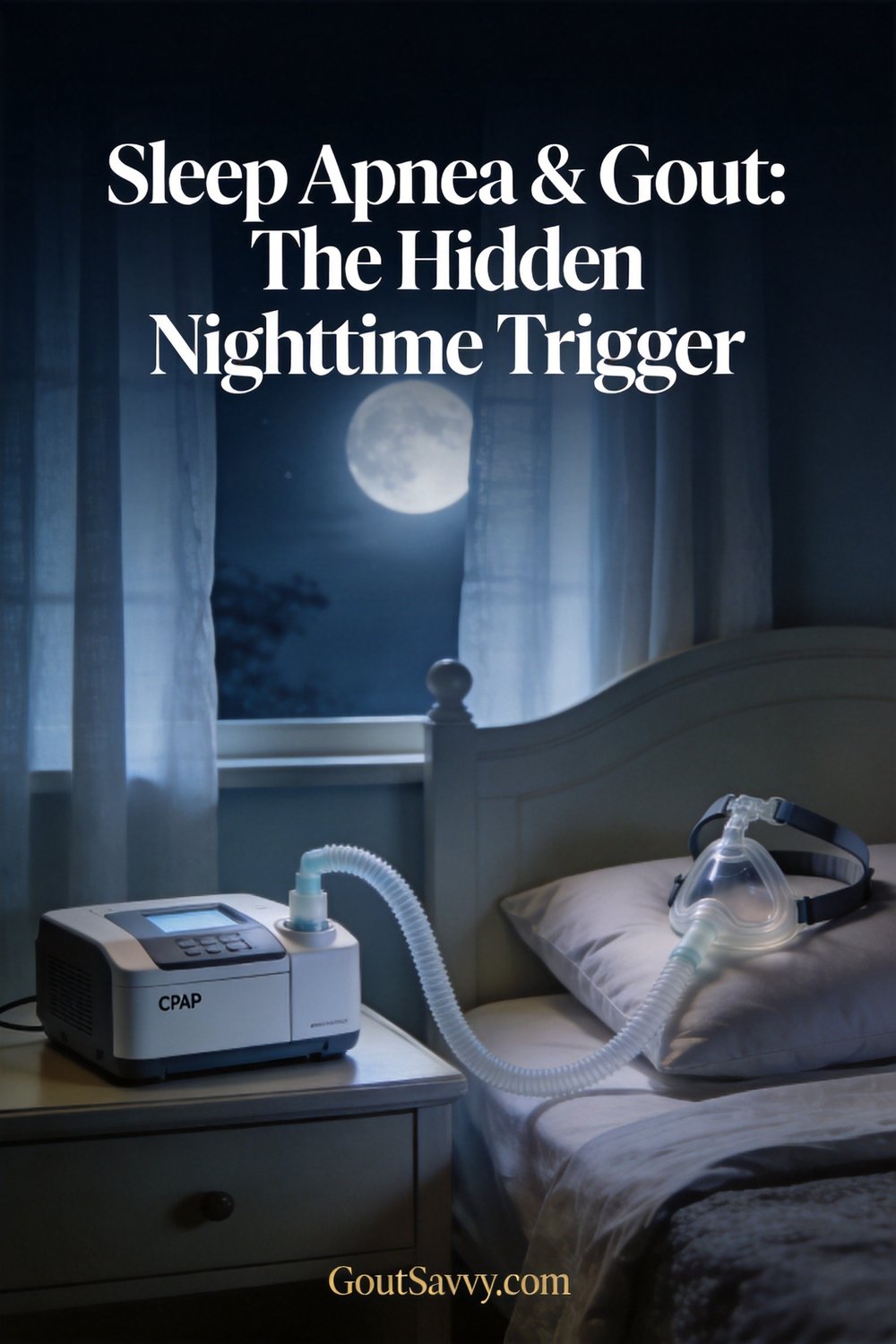
Obstructive sleep apnea is not just snoring. It is when your airway collapses repeatedly during sleep, cutting off oxygen for seconds at a time. This can happen dozens or even hundreds of times per night, and most people have no idea it is happening.
Each time your oxygen drops, a chain reaction starts that directly pumps uric acid into your bloodstream. Three things happen, and together they create what one researcher called “perfect storm conditions” for a gout flare.
The First Hit: Oxygen Starvation Triggers Uric Acid Production
When your cells cannot get enough oxygen, they cannot produce energy normally. They switch to a backup process that breaks down adenosine triphosphate (ATP), your cellular energy molecule.
Here is the problem: when ATP breaks down, it releases purines. And purines are the raw material your liver turns into uric acid.
So every time your oxygen drops during an apnea episode, your cells panic, burn through ATP, and dump purines into your blood. Your liver converts those purines to uric acid. This happens over and over, all night long. No food can cause uric acid spikes this fast.
The Second Hit: Acidosis Makes Uric Acid Crash Out of Solution
When you stop breathing, carbon dioxide builds up in your blood. This makes your blood more acidic.
Think of it like sugar dissolving in water. Warm water holds more sugar. Cold water holds less, and the sugar crystallizes and falls to the bottom. The same thing happens with uric acid in acidic blood. When your blood turns acidic during an apnea episode, it can hold less uric acid in solution, so the excess crystallizes out.
Those crystals land in your joints. That is your gout flare.
The Third Hit: Kidney Function Takes a Long-Term Beating
Chronic sleep apnea does not just cause short-term spikes. Over time, the repeated oxygen deprivation damages your kidneys. The glomerular filtration rate (GFR) drops, meaning your kidneys become less efficient at filtering uric acid out of your blood.
Less uric acid leaves your body. More stays in your blood. The cycle feeds itself.
If you want to understand why kidney health matters so much for gout, check out our deep dive on gout and kidney disease. The connection is a two-way street, and sleep apnea makes both directions worse.
Who Is Most at Risk?
A large UK population-based study looked at the connection between OSA and gout. At first glance, the risk almost doubled. But when researchers adjusted for body weight, kidney function, heart failure, and diuretic use, the overall association disappeared.
Does that mean sleep apnea does not matter? Not at all. It means certain groups still carried significantly elevated risk even after adjustment:
- Women with OSA had 64% higher gout risk (adjusted odds ratio 1.64).
- People with heart failure and OSA had nearly double the risk (adjusted odds ratio 1.82).
- Those with chronic kidney disease (CKD) stage 3 had more than double the risk (adjusted odds ratio 2.22).
- People with BMI over 35 had 56% higher risk (adjusted odds ratio 1.56).
- Recent diuretic users with OSA had 73-85% higher risk.
So if you are a woman with sleep apnea, or you have kidney issues, or you are on blood pressure pills, the risk is real. The shared factor here is that all these conditions already compromise either uric acid clearance or production. Add sleep apnea on top, and you are piling fuel on a fire.
This is also why gout attacks peak at night. Your body is lying horizontal, your breathing may be compromised, and all the mechanisms described above are firing simultaneously.
But Does Treating Sleep Apnea Actually Help Gout?
Here is where the story gets complicated.
A 2019 meta-analysis pooled five studies with 270 patients and found that continuous positive airway pressure (CPAP) treatment, the standard therapy for sleep apnea that uses gentle air pressure to keep your airway open, had no significant effect on uric acid levels overall.
A Spanish randomized controlled trial with 307 women found the same thing: 12 weeks of CPAP did not reduce uric acid compared to conservative treatment.
But here is the catch. Those studies looked at average uric acid levels over weeks. They did not capture what happens hour by hour during the night. Remember the three mechanisms? The first two (ATP breakdown and acidosis) disappear the moment you wake up and start breathing normally. A blood test drawn during the day would miss the overnight spike.
Some studies do show benefits. Research in the European Respiratory Journal found that consistent CPAP use over several months significantly reduced serum uric acid in patients with moderate to severe OSA. Another study noted that UA levels decrease following CPAP therapy or weight loss.
The truth is somewhere in the middle. CPAP may not dramatically lower your fasting uric acid on a lab report. But by stopping the nightly cycles of hypoxia, acidosis, and kidney stress, it removes the trigger that sets off many nighttime flares.
Think of it this way: if someone keeps throwing matches into a room, installing a fire alarm helps. But stopping the person from throwing matches helps more.
The Vicious Cycle: Gout Wrecks Your Sleep Too
The relationship runs both ways, and this is what makes it so hard to break.
Gout flares commonly strike at night. The pain is severe enough to wake you from deep sleep. One bad flare can destroy a week of sleep. And that lost sleep then raises cortisol, increases inflammation, worsens insulin resistance, and raises uric acid.
Which makes the next flare more likely.
Which destroys more sleep.
You see the problem.
Breaking this cycle means addressing both sides. Manage your uric acid with medication to prevent flares that wreck your sleep. And manage your sleep to prevent the metabolic disruption that raises uric acid. If you have been struggling with poor sleep and frequent flares, our guide on sleep and gout covers practical strategies in detail.
Signs You Might Have Sleep Apnea (And Not Know It)
An estimated 1 in 4 men and 1 in 10 women have some form of obstructive sleep apnea. Most are undiagnosed because the symptoms seem normal or annoying rather than dangerous.
Here are the signs worth investigating, especially if you have gout:
- Loud snoring that your partner complains about
- Waking up with a dry mouth or morning headache
- Feeling exhausted despite spending 8 hours in bed
- A partner noticing you stop breathing or gasp during sleep
- Difficulty concentrating during the day
- Being overweight, particularly carrying extra weight around your neck
- High blood pressure that is hard to control
If any of these sound familiar and you have gout, getting a sleep study could be one of the more important things you do for your joint health. A sleep study is painless, often done at home with portable equipment, and can tell you definitively whether your breathing is compromised at night.
The connection between stress, poor sleep, and gout flares is well established. Sleep apnea is simply the most extreme form of sleep disruption, and it comes with its own unique mechanism for driving up uric acid.
What Should You Actually Do?
First, talk to your doctor about getting a sleep assessment if you have any of the warning signs above. This is not something to self-diagnose or ignore.
If you do have sleep apnea, CPAP is the gold standard treatment. Yes, the research on uric acid reduction is mixed. But CPAP has proven benefits for cardiovascular health, blood pressure, and kidney function, all of which matter enormously for people with gout. You can read more about the cardiovascular risks in our article on gout and stroke risk.
Second, if you are overweight, weight loss is one of the few interventions that helps both conditions simultaneously. Even a 10% reduction in body weight can significantly improve OSA severity and lower uric acid. Our guide on weight loss and gout covers safe strategies that will not trigger flares.
Third, stay hydrated. Dehydration overnight concentrates uric acid in your blood, which is why many flares hit in the early morning hours. A small glass of water before bed can help offset overnight fluid loss. Learn more in our article on dehydration and gout.
Finally, do not stop your gout medication. Sleep apnea may be a contributing factor, but it is rarely the only one. Genetic predisposition, kidney function, diet, and medication adherence all play roles. Treating sleep apnea is an addition to your gout management plan, not a replacement for it.
The Bottom Line
Sleep apnea creates a biochemical perfect storm for gout: oxygen deprivation accelerates uric acid production, acidosis forces uric acid out of solution, and kidney damage slows clearance. Up to 89% of people with gout may have undiagnosed sleep apnea. If your gout flares mostly at night and you snore, feel exhausted during the day, or carry extra weight around your neck, ask your doctor about a sleep study. It could change your gout management more than any dietary tweak.
Frequently Asked Questions
Can sleep apnea directly cause gout?
Sleep apnea does not directly cause gout, but it creates conditions that make gout much more likely. The intermittent oxygen deprivation accelerates ATP breakdown, which produces purines that convert to uric acid. Over time, this can push uric acid levels high enough to trigger crystal formation and flares. Research shows people with OSA have significantly higher uric acid levels and gout rates than those without it.
Will using a CPAP machine lower my uric acid?
The evidence is mixed. Some studies show CPAP reduces serum uric acid over several months, while others find no significant change. The key issue is that CPAP stops the nightly hypoxia cycles that produce acute uric acid spikes, which may not show up on a daytime blood test. Even if your lab numbers do not change dramatically, CPAP can reduce nighttime flare triggers and improves cardiovascular and kidney health.
I have gout but I do not snore. Should I still get tested for sleep apnea?
Snoring is the most common symptom but not the only one. Other signs include daytime exhaustion, morning headaches, waking with a dry mouth, and a partner noticing breathing pauses. Some people with sleep apnea, especially women, do not snore loudly at all. If your gout flares predominantly at night and you have any risk factors like excess weight or high blood pressure, a sleep assessment is worth discussing with your doctor.
Can treating sleep apnea cure my gout?
Some clinicians report that treating sleep apnea can eliminate gout flares in certain patients, particularly those whose flares were primarily driven by nighttime hypoxia. However, gout is usually multifactorial, involving genetics, kidney function, diet, and medications. Treating sleep apnea can significantly reduce flare frequency but may not eliminate gout altogether if other factors are at play.
Are women with sleep apnea more likely to get gout?
A UK population study found that women with OSA had 64% higher gout risk even after adjusting for other factors, while the association in men disappeared after adjustment. This may be because women are more likely to be undiagnosed, and the metabolic impact of OSA may interact differently with hormonal factors. Postmenopausal women are already at elevated gout risk due to declining estrogen, and sleep apnea can amplify that risk further.
How is sleep apnea related to nighttime gout attacks?
Most gout flares occur during sleep, and sleep apnea may be a major reason why. The combination of oxygen deprivation, acidosis, dehydration overnight, and positional factors all converge during sleep to create ideal conditions for uric acid crystallization. If you wake up with gout pain regularly, sleep apnea screening could reveal a treatable contributing factor.
References
- Park J, et al. “Association between obstructive sleep apnea and hyperuricemia/gout in the general population: a cross-sectional study.” BMC Musculoskeletal Disorders. 2025;26:14. (KNHANES 2019-2021 data, 11,728 participants)
- Blagojevic-Bucknall M, et al. “Obstructive sleep apnea and the risk of gout: a population-based case-control study.” Arthritis Research & Therapy. 2020;22:43. (UK CPRD database, adjusted subgroup analysis)
- Campos-Rodriguez F, et al. “Continuous Positive Airway Pressure Treatment Does not Reduce Uric Acid Levels in OSA Women.” Archivos de Bronconeumología. 2019;55(4):201-207. (Spanish Sleep Network RCT, 307 women)
- Zhang X, et al. “Does Continuous Positive Airway Pressure Therapy in Patients with Obstructive Sleep Apnea Improves Uric Acid? A Meta-Analysis.” Medicine. 2019;98(41):e17488. (5 studies, 270 patients)
- Hirotsu C, et al. “Association between uric acid levels and obstructive sleep apnea syndrome in a large epidemiological sample.” PLoS ONE. 2013;8(6):e66891.
- Choi HK, et al. “Nocturnal risk of gout attacks.” Arthritis & Rheumatology. 2015;67(2):555-562.
- Sun Y, et al. “Independent and synergistic effects of sedentary lifestyle and obstructive sleep apnea on hyperuricemia: a nationwide cross-sectional study in Korea.” Frontiers in Public Health. 2026;14:1854396.
Reviewed by the GoutSavvy Editorial Team