Cooking Methods and Gout: How Preparation Affects Purines
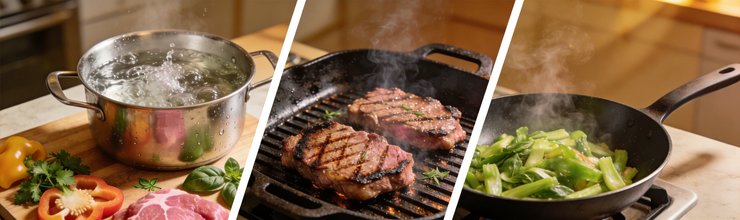
You know that steak is high in purines. But did you know that how you cook it matters just as much as what you’re cooking? Studies indicate that cooking methods significantly affect the purine content and health impact of foods.
Let’s explore the science of cooking for gout.
Understanding How Heat Affects Purines
When foods are heated, several changes occur that affect purine content and availability:
Cell Wall Breakdown
Heat breaks down plant and animal cell walls, making cellular contents, including purines, more accessible for digestion and absorption. This can actually increase the amount of purines your body absorbs from cooked food compared to raw.
Moisture Loss
Cooking causes water evaporation, concentrating purines per gram of food. A steak that weighed 200g raw might weigh 150g after cooking, the same purine content in less mass means higher concentration.
Maillard Reaction
The browning reaction that creates flavor in grilled, roasted, and fried foods produces advanced glycation end products (AGEs). AGEs promote inflammation, which may worsen gout symptoms even if purine content doesn’t change significantly.
How Much Purine Is Actually Reduced by Boiling?
Boiling is the cooking method most studied for purine reduction. Research from Japanese food science laboratories quantified purine losses across multiple food categories during boiling. A 10-minute boil of fresh shiitake mushrooms reduced purine content by approximately 55, 65%, while button mushrooms lost roughly 30, 40% of their purine content after 5 minutes of boiling. Asparagus boiled for 5 minutes showed a purine reduction of approximately 40, 50%, with longer boiling times up to 15 minutes producing diminishing returns. For fish and shellfish, boiling in water for 3, 5 minutes reduced purine content by approximately 15, 25%, lower than vegetable reductions because fish purines are more tightly bound to proteins. The key finding across these studies is that the first portion of boiling time produces the steepest purine loss, as water-soluble purine compounds rapidly diffuse into the cooking liquid. This is why the cooking liquid itself becomes highly purine-concentrated, a broth made from seafood bones or meat can contain the majority of purines extracted from the original ingredients.
Comparing Cooking Methods
Boiling and Stewing
Effect on purines: Can actually reduce purine content
Boiling transfers purines from food into the cooking water, especially true for vegetables and legumes. Studies show that boiling asparagus reduces purine content by up to 50%.
Gout consideration: This is generally the best cooking method for people with gout, particularly for vegetables and legumes. However, the cooking liquid (broth, soup stock) concentrates these purines, so avoid using it if you’re avoiding purines.
Grilling and Broiling
Effect on purines: May increase purine availability through cell wall breakdown
High, dry heat concentrates purines as moisture evaporates. Grilling also creates AGEs through the Maillard reaction.
Gout consideration: Use sparingly. When grilling, marinate meat (acidic marinades may reduce AGE formation) and avoid charring. Remove any visibly burned portions.
Frying
Effect on purines: Concentrates purines; adds unhealthy fats
Frying adds significant calories and can create inflammatory compounds. The high temperature also promotes AGE formation.
Gout consideration: Limit fried foods. If you fry, use stable oils (avocado oil, olive oil) and avoid overheating. Coconut oil is heat-stable but high in saturated fat.
Microwaving
Effect on purines: Minimal purine change
Microwaving causes less moisture loss and shorter cooking times compared to conventional methods, potentially preserving purine content closer to raw levels.
Gout consideration: Generally a better option than high-heat methods. However, uneven heating may leave some parts undercooked.
Steaming
Effect on purines: Minimal change; preserves nutrients
Steaming cooks food gently with moisture, minimizing purine concentration from water loss.
Gout consideration: An excellent cooking method for people with gout. Preserves nutrients and maintains food structure without high-heat damage.
Slow Cooking
Effect on purines: Long cooking time may extract purines into liquid
Like boiling, slow cooking in liquid can transfer purines to the cooking liquid.
Gout consideration: Choose lean cuts and skimming fat if gout is a concern. Use the cooking liquid for flavor but be aware it contains extracted purines.
AGE Formation by Cooking Method: The Numbers
Dietary advanced glycation end products (AGEs) are measurable in kilounits (kU) per 100g of food, and cooking method dramatically affects these values. A 90g serving of raw beef contains approximately 707 kU of CML (a major AGE), while a pan-fried beefsteak contains approximately 10,058 kU, roughly 14 times more. Roasting beef on a grill yields approximately 7,497 kU. Chicken shows a similar pattern: water-boiled (mizitaki-style) chicken contains only 957 kU per 90g, compared to 4,938 kU when pan-fried and 9,732 kU when deep-fried, roughly a 10-fold difference. Barbecued chicken with skin reaches 18,520 kU per 90g. Salmon cooked in a hot pan produces approximately 3,084 kU per 90g versus 528 kU for raw salmon. Even tofu, often considered a gout-safe food, rises from 488 kU (raw) to 3,569 kU when lightly sautéed. A meta-analysis of dietary AGE intake and health outcomes estimated that consuming a diet heavy in grilled or roasted meats, fats, and processed foods can yield daily AGE intake exceeding 20,000 kU, while a diet centered on steamed vegetables, legumes, and low-fat dairy can stay well below 10,000 kU. Research suggests that reducing dietary AGE intake by 50% is associated with lower oxidative stress and improved insulin sensitivity in animal studies.
Meat Broth and Bone Broth: The Numbers Behind the Risk
Many people with gout consume bone broth believing it to be a health food, but it concentrates purines dramatically. Measured purine content of meat-based broths commonly reaches 150, 300 mg of purine per 100 mL, depending on the ingredients and simmer time. Standard chicken broth made from simmering bones for 12, 24 hours can contain 150, 250 mg purine per cup (240 mL), roughly equivalent to eating 3, 4 oz of cooked chicken in terms of purine load. Beef bone broth, particularly from marrow-rich bones, can exceed 300 mg per 100 mL. A single cup of traditional beef consommé can therefore contribute as much purine as a moderate serving of steak. Commercial stock cubes and bouillon concentrates are even more concentrated, often containing the equivalent of 400, 600 mg purine per 100g of reconstituted product. For people with gout, this means soups and sauces made with meat-based stocks can be significant hidden sources of dietary purines, easily rivaling the purine content of the protein foods themselves.
Practical Cooking Tips for Gout
Meat Preparation
For a complete guide to making gout-friendly protein choices, see our article on protein and gout, which covers purine content by protein source and strategic meal planning.
- Choose lean cuts. Less fat means less overall purine load
- Trim visible fat. Fat tissue contains purines
- Marinate before grilling. Vinegar-based marinades may reduce AGE formation by more than 50% compared to untreated meat
- Avoid charring. Remove burned portions
- Pair with vegetables. Fiber helps offset some negative effects
- Consider boiling first. Boil meat briefly, then finish with other method
Vegetable Preparation
- Moderate high-purine vegetables. Asparagus, spinach, mushrooms are fine in normal amounts
- Don’t overcook – Some nutrients degrade with excessive cooking
- Use steaming or boiling – These methods don’t add significant purines and may reduce them
- Include variety – Different vegetables balance purine intake
Stock and Broth Considerations
This is where many people with gout go wrong. Meat-based stocks concentrate purines from bones and connective tissue. If you want to enjoy savory soups without triggering flares, see our guide to low-purine soup recipes for practical alternatives using vegetable stocks and purine-conscious ingredient selection.
- Avoid cream-based soups with meat broth as base
- Vegetable stocks are generally safe and very low in purines
- Bones contain high-purine marrow – Traditional bone broth is problematic for gout
- If using meat broth, consume sparingly and during flares
Foods That Are Always Safe
Regardless of cooking method, these foods are reliably low in purines:
- Low-fat dairy (milk, yogurt, cheese)
- Eggs
- Most fruits (especially cherries)
- Refined grains (white bread, pasta, white rice)
- Butter and oils (in moderation)
- Most nuts and seeds
- Coffee and tea
The Bigger Picture
While cooking methods matter, they’re part of a larger dietary picture. Research consistently shows that Mediterranean-style dietary patterns and the Dietary Approaches to Stop Hypertension (DASH) diet reduce serum uric acid more reliably than any single food or cooking technique. A diet rich in vegetables, low-fat dairy, and whole grains provides more gout benefit than obsessing over cooking methods alone.
- Overall purine intake matters more than single food preparation
- Portion sizes significantly affect purine load
- Frequency of consumption matters—occasional high-purine meals are different from daily habits
- Overall diet quality (Mediterranean, DASH) provides more benefit than obsessing over cooking methods
Frequently Asked Questions
How does cooking method affect purine content?
Cooking methods matter for purine management. Boiling leaches purines into cooking water (use the liquid for soups to retain nutrients). Grilling and broiling at high temperatures can create inflammatory compounds. Steaming and poaching are gentler preparation methods.
Should I avoid grilled foods with gout?
Not necessarily, but be mindful of what you grill. High-purine proteins grilled at very high temperatures may create advanced glycation end products that increase inflammation. Choose lower-purine proteins and avoid charring, which can increase inflammatory compounds.
Does pressure cooking change purine levels?
Pressure cooking can reduce purine content in some foods compared to traditional boiling while preserving nutrients. The sealed environment may help retain water-soluble nutrients. It is a practical cooking method for preparing gout-friendly meals efficiently.
What cooking oils are best for gout-friendly cooking?
Olive oil, avocado oil, and coconut oil are good choices. Olive oil has anti-inflammatory properties and is suitable for low-to-medium heat cooking. Avoid reusing cooking oils multiple times, as oxidation creates inflammatory compounds that may worsen gout symptoms.
References
- Chen-Xu M, Yokose C, Rai SK, Pillinger MH, Choi HK. Contemporary Prevalence of Gout and Hyperuricemia (high uric acid levels) in the United States. Arthritis Rheumatol. 2019;71(5):764-770. PubMed
- Neogi T, et al. 2015 Gout Classification Criteria. Arthritis Rheumatol. 2015;67(10):2557-2568. PubMed
- Richette P, Doherty M, Pascual E, et al. 2016 updated EULAR evidence-based recommendations for the management of gout. Ann Rheum Dis. 2017;76(1):29-42. PubMed
- Dalbeth N, Choi HK, Joosten LAB, et al. Gout. Lancet. 2021;397(10287):1843-1855. PubMed
- Choi HK, Atkinson K, Karlson EW, Willett W, Curhan G. Purine-rich foods, dairy and protein intake, and the risk of gout in men. N Engl J Med. 2004;350(11):1093-1103. PubMed
References
- PMC8678356. Role of Diet in Hyperuricemia and Gout. Best Practice & Research Clinical Rheumatology, 2022.
- Choi HK, et al. Purine-rich foods, dairy and protein intake, and the risk of gout in men. New England Journal of Medicine.
- USDA National Nutrient Database. Purine content of foods by cooking method.
- Uribarri J, et al. Advanced glycation end products in foods and a practical guide to their reduction in the diet. J Am Diet Assoc. 2010.
- Chen CY, et al. Effects of thermal processing on CML content in meat. Food Chemistry.
- UpToDate. Dietary approaches to hyperuricemia and gout.
- American College of Rheumatology (ACR) Guidelines for Management of Gout.
References
- Chen-Xu M, Yokose C, Rai SK, Pillinger MH, Choi HK. Contemporary Prevalence of Gout and Hyperuricemia (high uric acid levels) in the United States. Arthritis Rheumatol. 2019;71(5):764-770. PubMed
- PMC8678356. Role of Diet in Hyperuricemia and Gout. Best Practice & Research Clinical Rheumatology, 2022.
- Choi HK, et al. Purine-rich foods, dairy and protein intake, and the risk of gout in men. New England Journal of Medicine.
- USDA National Nutrient Database. Purine content of foods by cooking method.
- Uribarri J, et al. Advanced glycation end products in foods and a practical guide to their reduction in the diet. J Am Diet Assoc. 2010.
- Chen CY, et al. Effects of thermal processing on CML content in meat. Food Chemistry.
- UpToDate. Dietary approaches to hyperuricemia and gout.
- American College of Rheumatology (ACR) Guidelines for Management of Gout.
Reviewed by the GoutSavvy Editorial Team