
Your big toe finally calmed down. Two months later, at 2 a.m., a different pain wakes you up. Not the toe this time. It’s your side, knifing from your back toward your groin, and the toilet water is pink. Kidney stone. If you have gout, that second attack was not bad luck. It came from the same chemical causing both problems: uric acid.
About 1 in 6 people with gout will deal with a kidney stone at some point, and in a long-running study of more than 51,000 men, a gout diagnosis roughly doubled the risk. Here’s what is actually happening in your kidneys, why the stones often stay invisible on X-ray, and what works to stop the next one.
Gout Stones and Toe Stones Start the Same Way
Uric acid is a waste product. Your liver makes it from purines, the building blocks found in your own cells and in foods like organ meat, shellfish, and beer. Your kidneys then flush most of it out in urine. Humans lost the enzyme other mammals use to break uric acid down, so we are stuck dealing with a chemical that does not dissolve easily.
When blood levels run high and urine stays persistently acidic, uric acid does what sugar does in a cup of over-sweetened tea. It comes out of solution and forms crystals. In a joint, usually the big toe, those crystals trigger the fiery flare you know. In the kidney, they clump into a stone. Same crystals, different neighborhood.
Here is the detail most people miss. For gout stones in the kidney, the amount of uric acid in urine matters less than how acidic the urine is. Research on uric acid stone formation found that low urine pH is the dominant driver, with excess uric acid excretion a less common culprit. The cutoff to remember is roughly 5.5. Below it, uric acid turns insoluble fast. Above it, the same amount of acid may stay dissolved and simply wash out.
How Big Is the Risk, Really?
Gout affects roughly 3.9% of U.S. adults, about 9.2 million people, according to national survey data from 2015 to 2016. Kidney stones overall affect about 1 in 11 Americans. Where the two overlap, things get interesting.
In the Health Professionals’ Follow-Up Study, 15% of men with a history of gout had dealt with kidney stones, compared with 8% of men without gout. After adjusting for age and weight, gout nearly doubled stone risk (odds ratio 1.88), and prospectively it more than doubled the risk of a first stone over follow-up (relative risk 2.12). The reverse was not true: a stone history did not predict gout. The arrow runs from gout toward stones, which tells you lowering uric acid is the lever, not chasing the stone itself.
A 2026 analysis of 118,963 Taiwanese adults told the same story from the other direction. Kidney stones showed up in 5.4% of people with neither high uric acid nor gout, 8.5% of people with high uric acid alone, and 17.0% of people with gout alone. Gout explained roughly 24% of the link between high uric acid and stones in that analysis. The rest ran through a shared problem: insulin resistance, which keeps urine acidic.
That shared metabolism is why type 2 diabetes matters here. In a French series of 2,464 analyzed stones, uric acid stones made up 35.7% of stones in people with type 2 diabetes versus 11.3% in people without, and diabetes carried nearly seven times the adjusted risk (odds ratio 6.9). The same insulin resistance that drags down urine pH also feeds the gout-weight-blood sugar cluster.
What a Uric Acid Stone Feels Like (and the Fever Rule)
Classic symptoms include:
- Sudden, severe pain in one side of your lower back or flank, often traveling toward the groin.
- Waves of pain that crest and ease, unlike a constant muscle ache.
- Pink, red, or brown urine, or urine that looks cloudy and smells strong.
- A burning need to urinate often, with only small amounts coming out.
- Nausea, even vomiting, during the worst waves.
One quirk: uric acid stones are radiolucent, meaning a plain X-ray often sees right through them. A patient can have a textbook stone and a “normal” X-ray. Doctors typically use a non-contrast CT scan or ultrasound, sometimes paired with a urine dipstick showing pH below 5.5. If your doctor dismisses stone symptoms because the X-ray is clear, ask specifically about a CT and urine pH testing.
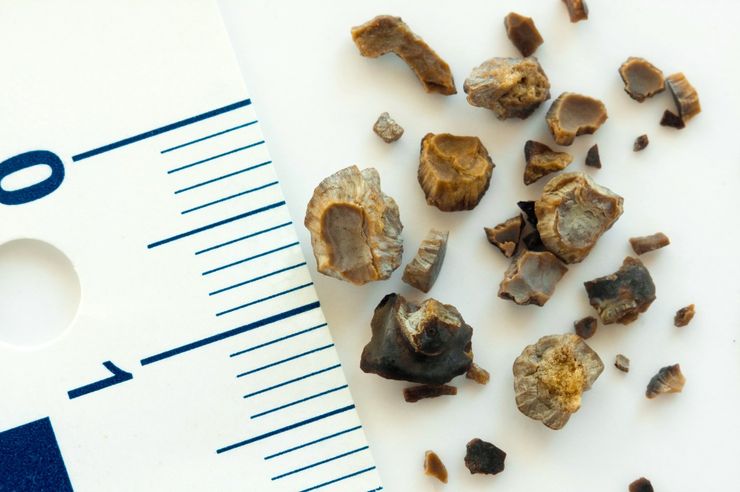
Some symptoms are not a wait-it-out situation. Fever or chills with a possible blocked stone means an infection behind an obstruction, which can turn septic fast. A stone with inability to urinate, or stone pain in a person with one kidney or during pregnancy, needs an emergency department. Do not try to dissolve that one at home.
The Moves That Actually Prevent the Next Stone
The good news is genuinely good. Unlike most other stone types, uric acid stones can often be dissolved with medication rather than surgery. A 2024 French series reported complete dissolution in 88% of kidney uric acid stones treated with potassium citrate and urine pH monitoring. Four practical levers follow, roughly in order of payoff.
1. Drink to urine color, not a glass count
Dilution is the oldest stone medicine and one of the few with randomized evidence. In a 5-year Italian trial, people after a first calcium stone who raised urine output enough to stay hydrated cut recurrences to 12% (12 of 99) versus 27% (27 of 100) in the untreated group, and pushed the average time to relapse from about 25 months to 39 months. Aim for urine that stays pale yellow, not dark. The standard practical target is about 2 to 2.5 liters of urine a day, which usually means drinking close to 3 liters when you account for losses. Spread it through the day rather than chugging at dinner.
2. Raise urine pH with citrate, not baking soda experiments
Potassium citrate is the standard prescription. In a classic study, 18 patients treated long term saw urine pH rise from an acidic 5.30 into the 6.19 to 6.46 range, and new stone formation crashed from 1.20 stones a year to 0.01. It works by grabbing hydrogen ions so uric acid stays in its soluble salt form. Target pH sits around 6.2 to 6.5; the sweet spot is not “as alkaline as possible,” because overshooting into persistently alkaline urine can breed a different stone type. This is a prescription that needs kidney function and potassium monitoring, especially if you take blood pressure medicines. Sodium bicarbonate is sometimes used instead, but the sodium load can raise blood pressure and fluid retention, so do not self-dose kitchen baking soda long term without a clinician.
3. Keep urate-lowering treatment going, or start it
The 2020 American College of Rheumatology gout guideline conditionally recommends urate-lowering therapy for people with gout who have a history of urolithiasis, the medical word for urinary stones. If you already take allopurinol or febuxostat, do not stop during a flare or after a stone, and do not let a normal-looking blood test during an attack fool you. The standard serum urate target is under 6 mg/dL, or under 5 mg/dL for severe disease. For stone prevention, medication is typically paired with alkalinization, since lowering blood uric acid alone does not fix acidic urine. Allopurinol has its own evidence in hyperuricosuric stone formers: in a double-blind trial, 100 mg three times daily cut the stone event rate from 0.26 to 0.12 events per patient-year compared with placebo in people with high urinary uric acid.
Starting allopurinol can itself trigger a flare as crystals loosen, which is why clinicians often cover the first months with low-dose colchicine or an anti-inflammatory. We covered the colchicine dosing and diarrhea trap in detail here.
4. Fix the diet and the metabolic engine
Food moves the needle less than medication, but it still matters and costs nothing. Cut back on organ meats, anchovies, sardines, heavy red meat, and beer, which both adds purines and acidifies urine. Fructose in sugary drinks spikes uric acid without making you full. Crash diets and dehydration from fasting or hard workouts concentrate urine, which is one reason people get stones after rapid weight loss. Steady weight loss helps more than extremes, because improving insulin resistance helps restore normal urine pH. More on which foods actually move the numbers in our 42-day diet breakdown.
If you take a thiazide water pill or low-dose aspirin, do not stop either on your own, but mention them to your doctor. Both can nudge uric acid up, and there are often easier swaps, such as losartan for blood pressure, that nudge it back down. We covered that interaction here.
Your Next Three Moves
First, if you have gout and have ever passed a stone, tell your rheumatologist or primary doctor. Stone history changes treatment. It supports staying on urate-lowering medication and often adding citrate. Second, ask for a 24-hour urine test if stones recur. That test measures urine volume, pH, calcium, uric acid, and citrate and tells your clinician which lever to pull instead of guessing. Third, start carrying water today and check your urine color. That one habit is free, starts now, and has no prescription delay.
Gout stones are not a separate disease you now have to fight. They are the same uric acid problem showing up one floor down. Fix the uric acid, fix the acid in your urine, and you usually take care of both.
Frequently Asked Questions
Are all kidney stones in people with gout made of uric acid?
No. Gout raises the odds of uric acid stones, but people with gout can also form calcium oxalate stones, and the two can coexist in the same kidney. That is why a stone you pass should be analyzed; the composition dictates prevention. A strainer during an episode is not overkill.
Can I dissolve a uric acid stone without surgery?
Often, yes. Uric acid stones are among the few stones that can be dissolved medically. Potassium citrate to raise urine pH, enough fluids, and sometimes allopurinol cleared 88% of stones in a recent monitored series. Large stones, obstruction, infection, or severe pain may still need urology procedures like lithotripsy or a ureteroscope.
Will drinking lemon water or baking soda work instead of potassium citrate?
Lemon water adds a modest amount of citrate and helps hydration, but it is usually not enough alkalinization on its own. Baking soda works chemically, yet its sodium load can worsen blood pressure, heart failure, and swelling, and getting the dose wrong is easy. If you are considering either, read our lemon water evidence review and talk with a clinician before a long-term bicarbonate habit.
Why did my uric acid blood test come back normal during a flare?
Serum uric acid often drops during an acute attack, sometimes below the threshold that got you into trouble, so a single in-flare test can look deceptively normal. Retest several weeks after the flare settles, and judge control by the off-flare trend toward under 6 mg/dL, not one reassuring number.
Do uricosuric gout medicines like probenecid make stones worse?
They can if urine is concentrated and acidic, because they push more uric acid out through the kidneys. With enough hydration and urine alkalinization the risk is manageable, but a history of uric acid stones is exactly the kind of detail that should steer the medication choice. Tell the prescriber before starting one.
References
- Chen-Xu M, Yokose C, Rai SK, Pillinger MH, Choi HK. “Contemporary Prevalence of Gout and Hyperuricemia in the United States and Decadal Trends: The National Health and Nutrition Examination Survey, 2007-2016.” Arthritis Rheumatol. 2019;71(6):991-999. PMID: 30618180. doi:10.1002/art.40807
- Kramer HJ, Choi HK, Atkinson K, Stampfer M, Curhan GC. “The association between gout and nephrolithiasis in men: The Health Professionals’ Follow-Up Study.” Kidney Int. 2003;64(3):1022-1026. PMID: 12911552. doi:10.1046/j.1523-1755.2003.t01-2-00171.x
- Liu MS, Wang SH, Lee JI, Chen SC, Huang SP, Geng JH. “Sex-Specific Associations Between Hyperuricemia and Kidney Stone Disease in a Large Taiwanese Cohort.” Int J Med Sci. 2026;23(1):53-62. PMID: 41399372. doi:10.7150/ijms.109742
- Scales CD Jr, Smith AC, Hanley JM, Saigal CS; Urologic Diseases in America Project. “Prevalence of kidney stones in the United States.” Eur Urol. 2012;62(1):160-165. PMID: 22498635. doi:10.1016/j.eururo.2012.03.052
- Daudon M, Traxer O, Conort P, Lacour B, Jungers P. “Type 2 diabetes increases the risk for uric acid stones.” J Am Soc Nephrol. 2006;17(7):2026-2033. PMID: 16775030. doi:10.1681/ASN.2006030262
- Maalouf NM, Cameron MA, Moe OW, Sakhaee K. “Novel insights into the pathogenesis of uric acid nephrolithiasis.” Curr Opin Nephrol Hypertens. 2004;13(2):181-189. PMID: 15202612. doi:10.1097/00041552-200403000-00006
- Pak CY, Sakhaee K, Fuller C. “Successful management of uric acid nephrolithiasis with potassium citrate.” Kidney Int. 1986;30(3):422-428. PMID: 3784284. doi:10.1038/ki.1986.201
- Normand M, Haymann JP, Daudon M. “Medical treatment of uric acid kidney stones.” Can Urol Assoc J. 2024;18(11):E339-E345. PMID: 38976892. doi:10.5489/cuaj.8774
- Borghi L, Meschi T, Amato F, Briganti A, Novarini A, Giannini A. “Urinary volume, water and recurrences in idiopathic calcium nephrolithiasis: a 5-year randomized prospective study.” J Urol. 1996;155(3):839-843. PMID: 8583588.
- Ettinger B, Tang A, Citron JT, Livermore B, Williams T. “Randomized trial of allopurinol in the prevention of calcium oxalate calculi.” N Engl J Med. 1986;315(22):1386-1389. PMID: 3534570. doi:10.1056/NEJM198611273152204
- FitzGerald JD, Dalbeth N, Mikuls T, et al. “2020 American College of Rheumatology Guideline for the Management of Gout.” Arthritis Care Res (Hoboken). 2020;72(6):744-760. PMID: 32391934. doi:10.1002/acr.24180
Reviewed by the GoutSavvy Editorial Team