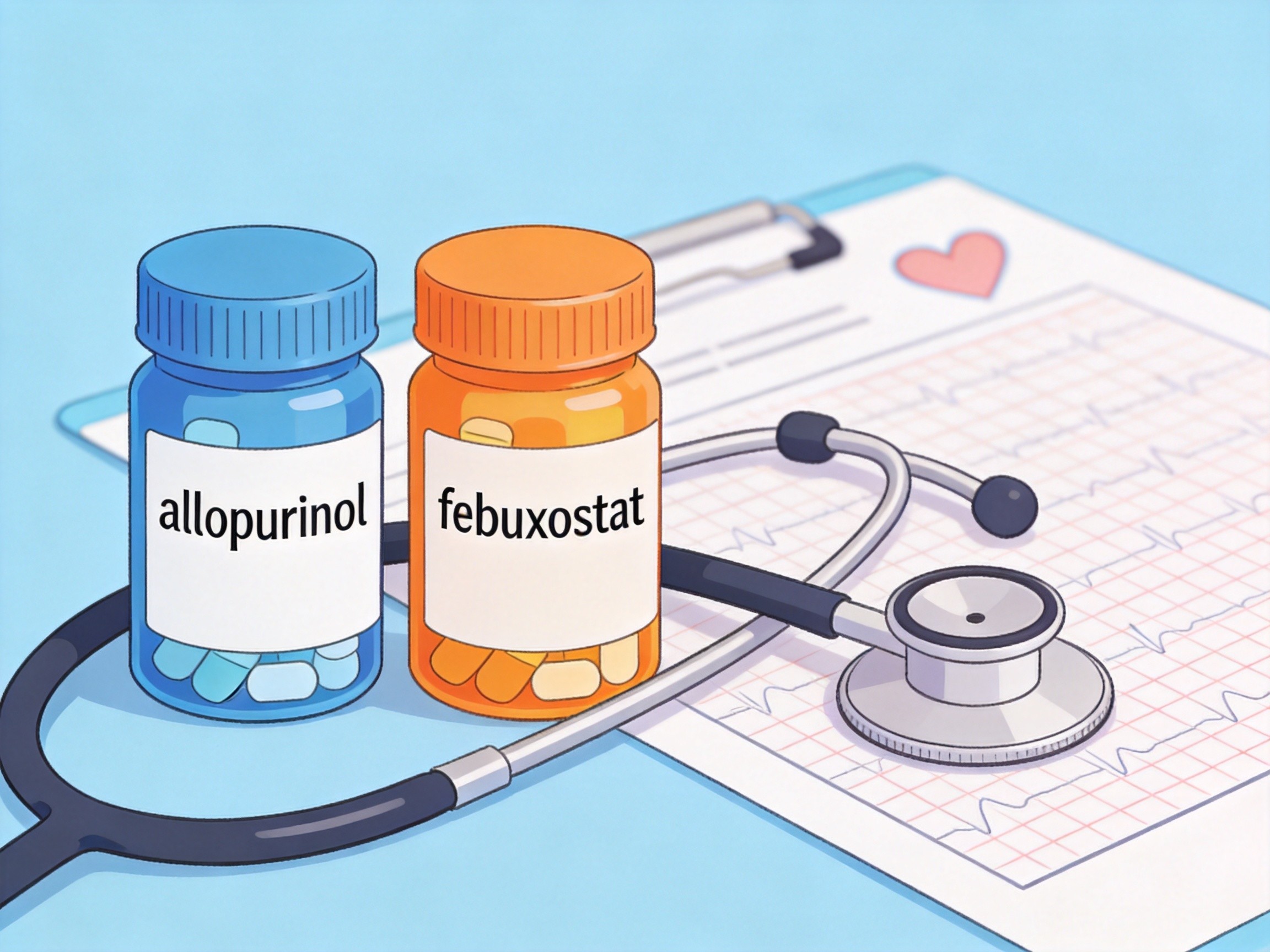
Understanding Urate-Lowering Therapy
Urate-lowering therapy (ULT) represents the cornerstone of gout management, addressing the root cause of the disease by reducing serum uric acid levels. Among the available ULT options, allopurinol and febuxostat are the two most commonly prescribed xanthine oxidase inhibitors (XOIs) in the United States. Understanding the differences between these medications is essential for optimal treatment decisions.
How Xanthine Oxidase Inhibitors Work
Both allopurinol and febuxostat work by inhibiting xanthine oxidase, the enzyme responsible for converting hypoxanthine and xanthine into uric acid. By blocking this pathway, these medications reduce uric acid production, allowing urate crystals to dissolve over time and preventing new crystal formation. This approach addresses the hyperuricemia that underlies all manifestations of gout.
Allopurinol: The First-Line Standard
Allopurinol has been the gold standard for urate-lowering therapy since its approval in 1966. Its extensive track record, proven efficacy, and lower cost make it the preferred initial choice for most patients according to ACR guidelines.
Mechanism and Metabolism
Allopurinol is a structural analog of hypoxanthine that irreversibly inhibits xanthine oxidase. It is metabolized by the liver to oxypurinol (alloxanthine), which also possesses xanthine oxidase inhibitory activity. Key pharmacokinetic features include:
- Half-life of 1-2 hours (allopurinol) and 15-30 hours (oxypurinol)
- Primary excretion through the kidneys
- Requires dose adjustment in renal impairment
- Once-daily dosing with flexible timing
Recommended Dosing Strategy
Modern allopurinol dosing differs significantly from historical practices. The “start low and go slow” approach minimizes the risk of medication-induced flares:
- Starting dose: 100 mg daily (50 mg if renal impairment)
- Target dose: 300-600 mg daily for most patients
- Maximum dose: 800 mg daily in selected cases
- Dose titration: Increase by 100 mg every 2-4 weeks until uric acid target achieved
Serum uric acid should be monitored monthly during titration, with a goal of maintaining levels below 6 mg/dL (or 5 mg/dL for patients with tophi or severe disease).
Common Side Effects
Allopurinol is generally well-tolerated, though several adverse effects warrant attention:
- Mild: Skin rash (5%), gastrointestinal upset, headache
- Serious (rare): Allopurinol hypersensitivity syndrome (AHS), Stevens-Johnson syndrome
- AHS risk factors: Renal insufficiency, concurrent thiazide diuretic use, HLA-B*5801 positivity (more common in Asian and African populations)
Febuxostat: The Potent Alternative
Febuxostat (Uloric) received FDA approval in 2009 as an alternative to allopurinol, particularly for patients who cannot tolerate allopurinol or require greater uric acid reduction.
Mechanism and Metabolism
Febuxostat is a selective non-purine xanthine oxidase inhibitor that differs structurally from allopurinol. Its pharmacokinetic profile includes:
- Half-life of 5-8 hours
- Metabolism primarily through hepatic glucuronidation and oxidation
- Minimal renal excretion (allows use in renal impairment)
- Once-daily dosing with or without food
Approved Indications and Dosing
Febuxostat is FDA-approved for chronic management of hyperuricemia in patients with gout. Available doses include:
- Starting dose: 40 mg daily
- Standard dose: 40-80 mg daily
- Maximum dose: 120 mg daily (requires monitoring)
Like allopurinol, febuxostat titration should proceed gradually, and prophylactic colchicine or NSAIDs are recommended during initiation.
The CARES Trial: A Game-Changer
In 2018, the CARES (Cardiovascular Safety of Febuxostat and Allopurinol in Patients with Gout and Cardiovascular Morbidities) trial dramatically reshaped the febuxostat landscape. This FDA-mandated post-marketing study of 6,190 patients revealed concerning findings:
Key CARES Trial Results
The trial demonstrated that febuxostat was non-inferior to allopurinol for the primary composite endpoint of cardiovascular death, non-fatal MI, non-fatal stroke, and unstable angina. However, striking differences emerged when components were analyzed separately:
| Outcome | Febuxostat | Allopurinol | Hazard Ratio |
|---|---|---|---|
| Cardiovascular death | 2.7% | 1.8% | 1.34 (p=0.03) |
| All-cause mortality | 7.8% | 6.4% | 1.22 (p=0.04) |
| Sudden cardiac death | 1.8% | 0.9% | 2.03 |
FDA Black Box Warning
Based on CARES findings, the FDA added a black box warning to febuxostat labeling in 2019, noting increased risk of cardiovascular death and all-cause mortality compared to allopurinol. Current guidelines recommend:
- Reserving febuxostat for patients who do not achieve target uric acid with allopurinol or cannot tolerate it
- Informing patients of cardiovascular risks
- Using lowest effective dose
- Monitoring for cardiac symptoms
The FAST Trial: Counterbalancing Evidence
In 2020, the FAST (Febuxostat versus Allopurinol Streamlined Trial) study provided a different perspective. This European trial of 6,128 patients found:
- Non-inferiority for the primary endpoint (hospitalization for cardiac arrhythmia, MI, stroke, or heart failure)
- Lower cardiovascular mortality with febuxostat (0.5%) vs allopurinol (1.2%)
- Lower all-cause mortality with febuxostat (4.3%) vs allopurinol (6.2%)
Critics note important differences: FAST enrolled patients with lower baseline cardiovascular risk and excluded those with recent MI or stroke. The conflicting evidence underscores the complexity of cardiovascular risk assessment in gout patients.
Head-to-Head Comparison
| Factor | Allopurinol | Febuxostat |
|---|---|---|
| FDA approval year | 1966 | 2009 |
| Mechanism | Non-selective XOI (irreversible) | Selective XOI (reversible) |
| Typical dose range | 100-600 mg daily | 40-80 mg daily |
| Renal dosing | Requires adjustment | No adjustment needed |
| Hepatic metabolism | Minimal | Primary route |
| Cost (generic available) | Low ($10-30/month) | Moderate ($300-400/month) |
| Cardiovascular safety | Established, long-term data | Black box warning |
| Hypersensitivity risk | Higher (AHS) | Lower |
| HLA-B*5801 concern | Yes (screen in high-risk) | No |
Choosing Between Allopurinol and Febuxostat
Individual factors guide the optimal medication choice:
Prefer Allopurinol When:
- No prior allopurinol use or failure
- Low-to-moderate cardiovascular risk
- Renal function is stable (dose adjustment acceptable)
- Cost is a significant consideration
- Patient prefers established track record
Consider Febuxostat When:
- Allopurinol intolerance (rash, hypersensitivity)
- Inadequate uric acid reduction despite maximum allopurinol dose
- Significant renal impairment (eGFR less than 30 mL/min)
- Patient prefers once-daily dosing flexibility
- Physician and patient accept cardiovascular risk discussion
Essential Monitoring Guidelines
Regardless of medication choice, proper monitoring ensures safety and efficacy:
- Uric acid: Check every 2-4 weeks during titration, then every 6 months
- Renal function: Monitor creatinine annually (more frequently if impairment)
- Liver function: Baseline and periodically during febuxostat therapy
- Cardiovascular: Baseline risk assessment, symptom monitoring during febuxostat therapy
- Flare prophylaxis: Continue colchicine or NSAID prophylaxis for 3-6 months after ULT initiation
Key Takeaways
- Both allopurinol and febuxostat effectively lower uric acid through xanthine oxidase inhibition
- Allopurinol remains first-line therapy due to extensive experience and lower cost
- Febuxostat offers higher uric acid reduction and renal-friendly metabolism
- CARES trial showed increased cardiovascular mortality with febuxostat; FAST trial findings were more favorable
- Current guidelines recommend allopurinol first, reserving febuxostat for specific indications
- Proper dose titration and flare prophylaxis are essential for both medications
- Shared decision-making should incorporate cardiovascular risk, cost, and patient preferences
References
- American College of Rheumatology. 2020 Guideline for the Management of Gout. Arthritis Care & Research. 2020.
- White WB, et al. Cardiovascular Safety of Febuxostat or Allopurinol in Patients with Gout. New England Journal of Medicine. 2018;378:1200-1210.
- Mackenzie IS, et al. Cardiovascular safety of febuxostat compared with allopurinol in patients with gout (FAST): a randomised, open-label, non-inferiority trial. Lancet. 2020;396:1745-1757.
- FDA Drug Safety Communication. FDA adds boxed warning for increased risk of death with gout medicine Uloric (febuxostat). 2019.
- Stamp LK, et al. Starting dose is a predictor of clinically significant allergy to allopurinol. Rheumatology. 2010;49:897-901.