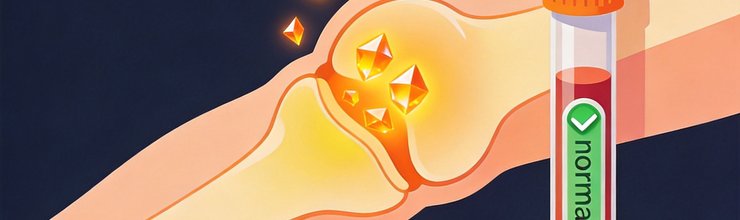
Here is something I hear all the time from readers: “My uric acid test came back normal. So why does my joint still feel like it is on fire?”
If that sounds familiar, you are not losing your mind. Plenty of people with gout walk into their doctor is office with a lab report that says everything looks fine, right before they wince while putting on their shoe.
Uric acid numbers and joint pain do not always move in sync. Understanding why can save you months of confusion and help you actually fix what is going on.
What “Normal” Actually Means on Your Lab Report
Most labs mark “normal” uric acid between 3.5 and 7.2 mg/dL. But here is the catch: that range is based on statistics, not your individual joints. For a deeper dive into what those numbers actually mean, check out our uric acid levels chart.
Think of it this way. Your body is like a bathtub. Uric acid is the water. Your kidneys are the drain. “Normal” on your lab report just means the water level is not overflowing. It says nothing about the gunk stuck to the sides of the tub.
That gunk is uric acid crystals. They build up in your joints over months, sometimes years. Even if your blood uric acid drops to a perfectly normal number today, those crystals can still be sitting there, ticking like tiny time bombs.
The Gap Between Blood Tests and Joint Reality
Your blood test tells you what is floating around in your bloodstream right now. It does not show you what has been deposited in your joints over time.
This is what rheumatologists call “urate burden”: how much crystallized uric acid has already settled in your tissues. Some people walk around with a high urate burden but completely normal blood uric acid. Others have elevated blood uric acid for years without ever developing crystals.
Why the difference? Three things matter most:
- Duration of elevated uric acid. Longer exposure means more time for crystals to form.
- Joint temperature. Your big toe stays cooler than your core body temperature. That is why gout loves it. Cooler joints make it easier for uric acid to crystallize.
- Individual biology. Some people naturally form crystals more easily. Genetics often play a role here.
Why Your Immune System Does Not Just “Ignore” the Crystals
Here is where the pain actually comes from. It has almost nothing to do with the number on your lab report.
Uric acid crystals in your joints are not just sitting there quietly. Your immune system sees them as foreign invaders. When white blood cells try to engulf these crystals, they burst open and release inflammatory signals.
That inflammatory burst is what you feel as a gout flare. Your pain intensity is not directly tied to your blood uric acid level. It is tied to how your immune system reacts to the crystals already there.
This is also why inflammation can persist even after your blood uric acid looks good. The inflammatory process in the joint takes time to calm down. Sometimes weeks after the blood uric acid has normalized.
The Two Most Common Reasons Your Pain Lingers
Reason 1: Crystals Are Still in the Joint
If you have had gout flares before, there is a good chance some uric acid crystals are still lodged in your joint cartilage and soft tissues. These crystals can continue to trigger low-grade inflammation even between obvious attacks. For tips on preventing future flares, see our guide to gout attacks at night.
This is called “subclinical inflammation,” which means it is happening at a level you might not notice day-to-day, but it is still wearing on your joint.
Research suggests it can take 12 to 24 months of consistently keeping uric acid below 6.0 mg/dL to actually dissolve existing crystal deposits. If you have only been on urate-lowering therapy (ULT) for a few months, the crystals may not be gone yet. Just quieter.
Reason 2: Inflammation Has Damaged the Joint
Repeated gout attacks do not just hurt in the moment. They can leave lasting changes in the joint. The cartilage can thin. The bone underneath can develop small cysts. The joint lining can thicken.
These structural changes can cause pain independent of uric acid levels. It is similar to how an old injury might ache when the weather changes, even though the original trauma happened years ago.
If your X-rays or ultrasound show joint damage from past flares, that is a separate problem from uric acid control. It needs its own management plan.
How to Figure Out What Is Actually Going On
Here is what I would suggest if your uric acid looks normal but your joint still hurts:
- Ask for an ultrasound or dual-energy CT (DECT) scan. These imaging techniques can show whether uric acid crystals are still in your joints. A blood test cannot tell you this. Some rheumatology offices have ultrasound right in the exam room.
- Get your uric acid tested during a flare, not just between attacks. Uric acid often drops during an acute attack because your body is inflamed. If you have only been tested when you feel okay, you might be missing the full picture.
- Check your kidney function. Your kidneys clear about two-thirds of the uric acid in your body. If kidney function is not optimal, your uric acid management might be incomplete even if the blood number looks “fine.”
- Track your uric acid over time. One reading does not tell you much. Three to six months of consistent readings, all done at the same lab and same time of day, gives you a much clearer trend.
What Actually Helps When Pain Sticks Around
1. Push uric acid lower than “normal.” For people with active gout and crystal deposits, most guidelines recommend keeping uric acid below 6.0 mg/dL. Some experts suggest going even lower, below 5.0 mg/dL, if you have tophi or persistent inflammation. “Normal” on a lab report often is not low enough to dissolve existing crystals. Learn more about urate-lowering therapy options.
2. Do not stop medication during a flare. This is a mistake I see a lot. When a flare hits, people sometimes stop their uric acid-lowering drug because they think it is causing the attack. It is not. The attack is caused by crystals shifting. Keep taking your medication. Work with your doctor on anti-inflammatory strategies for the flare itself.
3. Give it time. If you have just started urate-lowering therapy (ULT), give it at least 6 months before deciding whether it is working. Full crystal dissolution can take 1-2 years of consistent treatment. Patience here actually pays off.
4. Address joint health directly. If imaging shows joint damage, ask your doctor about physical therapy, joint support strategies, or other approaches that can help with pain coming from structural changes rather than active inflammation.
The Bottom Line
Your lab report is one piece of the puzzle, not the whole picture. Normal uric acid does not mean your joints are in the clear. It means your blood uric acid level is within a statistical range. Useful information, but not the full story.
If you are still hurting, the most important next step is getting imaging that can actually see what is happening inside your joints. From there, you and your doctor can make a plan tailored to what is really going on, not just what is showing on a piece of paper.
Most of the time, there is a path forward. You just have to find out what is actually driving the pain.
Frequently Asked Questions
Can gout pain continue even with normal uric acid levels?
Yes. Uric acid crystals can remain lodged in your joints even after blood levels normalize. These crystals can continue triggering inflammation, and joint damage from past flares can cause lingering pain independent of current uric acid levels.
How long does it take to dissolve uric acid crystals in the joints?
Research suggests it can take 12 to 24 months of consistently keeping uric acid below 6.0 mg/dL to significantly reduce existing crystal deposits. The exact timeline varies based on how much crystal burden you started with and how well your treatment keeps uric acid controlled.
Should I stop my gout medication if my uric acid is normal?
No. Stopping urate-lowering therapy (ULT) when your uric acid looks normal usually causes it to rise again. That gives existing crystals a chance to grow. Work with your doctor on the right treatment duration. For most people with recurrent gout, long-term management is needed.
What imaging can detect uric acid crystals in joints?
Ultrasound and dual-energy CT (DECT) can visualize uric acid crystal deposits in joints. Ultrasound is often used first because it is less expensive and widely available. DECT can distinguish uric acid crystals from other types of deposits with high accuracy.
Why does my gout hurt more at night?
Several factors contribute to nighttime gout pain. Joint temperature drops at night, which can make uric acid crystallize more easily in the extremities. Also, your body is natural anti-inflammatory hormone (cortisol) levels peak during the day and drop at night, making inflammation harder to control while you sleep.
Can joint damage from gout be reversed?
Some structural damage from gout, such as bone erosions or cartilage loss, may not fully reverse even with successful uric acid control. However, proper treatment can prevent further damage and, in some cases, the body can repair some of the inflammation-related changes. Early treatment gives you the best chance of preserving joint function.
What uric acid level is low enough to dissolve crystals?
Most guidelines recommend keeping uric acid below 6.0 mg/dL (360 micromoles per liter) to allow crystal dissolution. For people with tophi or severe disease, some experts recommend going below 5.0 mg/dL (300 micromoles per liter) for a period of time. Your doctor can help you set a target based on your specific situation.
How can I tell if my joint pain is from gout or something else?
Joint pain from gout typically comes on suddenly, affects one joint at a time (often the big toe), and is accompanied by redness, warmth, and swelling. If your pain is gradual, affects multiple joints symmetrically, or does not match the classic gout pattern, it may be worth seeing a rheumatologist for evaluation. Other conditions, like pseudogout, infection, or rheumatoid arthritis, can sometimes look similar.
References
- Pascart T, Grandjean A, Capon B, et al. Monosodium urate crystal deposition in the knee is associated with the number of gout attacks in gout. Rheumatology. 2023;62(7):2440-2447.
- Taylor FR. Clinical considerations for strategies to achieve uric acid target goals in gout. Rheumatology. 2022;61(5):1853-1862.
- Ottaviani S, Aubin F, Cancarere G. Ultrasound and dual-energy CT in gout: a review. Joint Bone Spine. 2021;88(4):105145.
- Richette P, Doherty M, Pascual E, et al. 2016 updated EULAR evidence-based recommendations for the management of gout. Ann Rheum Dis. 2017;76(1):29-42.
- Fiengo L, Ramachandran M. Clinically Relevant Features of Radiological Imaging in Gout. JCR: Journal of Clinical Rheumatology. 2020;26(5):e108-e113.
Reviewed by the GoutSavvy Editorial Team