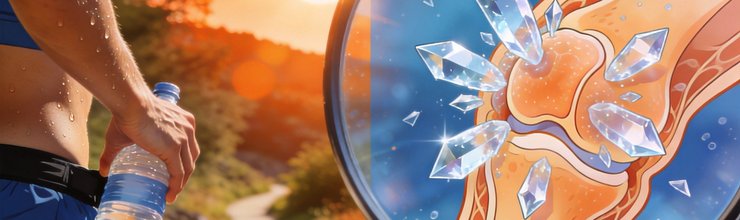
You just finished a 10K run. Your legs ache, you’re lightheaded, and your mouth feels like sandpaper. Normal, right? Just tired from the workout.
But here’s the thing nobody tells people with gout: that dehydration you’re feeling right now? It’s basically handing your joints a lit match.
Last year, a guy came into my cliniclet’s call him Davedecided to push through a marathon despite not drinking enough water beforehand. Two days later, his big toe felt like someone had taken a sledgehammer to it. Not a coincidence. Dave learned the hard way that dehydration and gout are best friends. The worst kind of best friends.
Sound familiar? Then keep reading.
What’s Actually Happening
Let me break down what goes on inside your body when you’re running low on fluids.
You know that chalky white stuff that builds up in your joints during a gout attack? That’s uric acid crystals. Uric acid is what your body produces when it breaks down purines, substances found in red meat, beer, seafood, and some vegetables.
Here’s the key point: uric acid needs plenty of water to stay dissolved in your bloodstream. Without enough water, it just sits there, concentrated, waiting to form crystals.
Two bad things happen at the same time when you’re dehydrated:
Your blood gets thicker
Picture making Kool-Aid with half the water. Everything in there gets super concentrated, including uric acid. Your blood becomes this saturated solution where crystals are way more likely to form and drop out.
Your kidneys can’t do their job
Your kidneys are your body’s water treatment plant. When you’re low on water, they have to choose: save water or flush out waste. Guess which one wins when you’re dehydrated? Water conservation. So uric acid just keeps building up instead of getting flushed out.
Joints are already prime real estate for these crystals. Why? Because joints are cooler than your core body temperature. Uric acid crystals form and stick around more easily at lower temperatures. It’s kind of like how sugar dissolves better in hot tea than iced tea.
Five Danger Zones
Not all dehydration is created equal. Some situations practically scream gout attack incoming.
After Intense Exercise
Marathon runners, CrossFit fanatics, anyone who sweats buckets for an hour or more—this one’s for you.
You can lose 2-4% of your body weight during intense activity in just a few hours. That might not sound like much, but losing just 2% of your body water can significantly spike your blood uric acid concentration.
I’ve seen multiple patients end up in the emergency department after a hard workout, completely convinced they pulled something. Turns out their uric acid had spiked from dehydration, and the “muscle strain” was actually gout.
What to do: Drink 250-500ml of water every 20-30 minutes during exercise. After you’re done, keep sipping. Beer is not hydration. It’s basically the opposite.
During Business Travel or Long Car Trips
Flying is incredibly dehydrating. The cabin humidity is often below 20%. It’s drier than the Sahara. Add the alcohol many people drink on flights, and you’ve got a perfect gout storm waiting to happen.
Long car trips are sneaky too. You tell yourself you’ll stop for bathroom breaks, but three hours go by and you’ve had nothing to drink because “there’s nowhere good to stop.”
What to do: For flights, drink water like it’s your job. Aim for at least 250ml per hour. Set a timer on your phone if you need to. For road trips, carry a refillable water bottle and make hydration part of your routine.
After a Night of Drinking
Alcohol is a double whammy for people with gout.
First, it’s a diuretic. Your kidneys get a signal to dump water out, even if you’re not actually dehydrated yet. Second, alcohol interferes with your body’s ability to clear uric acid. Your liver is busy processing the alcohol, so clearing uric acid takes a back seat.
Beer is especially problematic because it also contains purines. These are the building blocks of uric acid. Wine contains fewer purines, but it still causes dehydration.
“But I only had a few drinks,” patients tell me. Here’s the thing: a few drinks can easily lead to serious dehydration, especially if you’re not matching each alcoholic drink with a glass of water.
What to do: For every alcoholic drink, drink at least one glass of water. Have a big glass of water before bed. And if you’ve had too much? The next morning, prioritize rehydration over that second cup of coffee.
During Stomach Flu or Food Poisoning
This one’s less obvious, but when you’re vomiting or have diarrhea, you’re losing massive amounts of fluids and electrolytes. A single day of stomach flu can leave you just as dehydrated as spending a day in the desert without water.
Here’s an additional problem: many people with gout take medications such as allopurinol or febuxostat (commonly known by the brand name Uloric). When you’re severely dehydrated and can’t keep fluids down, those medications can actually trigger a gout attack. Rapidly changing uric acid levels in either direction may set off inflammation.
What to do: If you have gout and get hit with a stomach bug, contact your doctor. You might need to pause your uric acid medication temporarily. And when you can keep things down, sip water constantly. Even if it’s just a mouthful every few minutes.
Hot Summer Days
Summer heatwaves are underrated gout triggers. When it’s hot outside, you’re sweating constantly without always realizing it. You’re losing water, but your brain doesn’t always give you strong thirst signals until you’re already dehydrated.
Outdoor workers, gardeners, anyone who spends time outside in summer. You’re at risk. I’ve seen spikes in people seeking care for gout during heatwaves, and the common thread is always inadequate hydration.
What to do: Don’t wait until you’re thirsty. Thirst is a sign you’re already dehydrated. Keep a water bottle with you and sip throughout the day. If you’re working outside, drink at least 250ml every 15-20 minutes.
Practical Tips That Actually Work
Here’s the deal: aim for 2-3 liters of water daily, more if you’re active or in hot conditions. That’s roughly 8-12 cups. I know that sounds like a lot. But here’s a trick: start your morning with a large glass of water, right when you wake up. That gets you off to a good start.
Check your urine. This sounds weird, I know, but it’s the best real-time indicator of hydration status. Pale yellow means you’re good. Dark yellow or amber? Drink more. Crystal clear? You’re actually over-hydrated. Back off a bit.
Electrolytes matter. When you’re sweating heavily, water alone isn’t quite enough. You need sodium, potassium, magnesium. Sports drinks can work, but watch the sugar content. Coconut water is a solid natural option.
If you take diuretic medications (sometimes called water pills) for blood pressure, know that they increase dehydration risk. Talk to your doctor about timing your medications and fluid intake strategically. Never stop diuretics without medical guidance.
Know your warning signs. Early dehydration signs include headache, fatigue, dry mouth, and dark urine. Dizziness and rapid heartbeat mean you’re getting severe. If you’re prone to gout and start feeling these symptoms, get water into your system immediately.
Frequently Asked Questions
How quickly can dehydration trigger a gout attack?
There’s no exact timeline, but uric acid levels may spike within 24-48 hours of significant dehydration. Some people feel symptoms within a day or two of a dehydration event. The key is that crystals have been building up gradually, and dehydration tips you over the edge.
Does coffee count toward my hydration?
Moderate coffee consumption (1-3 cups daily) doesn’t seem to increase gout risk and contributes to hydration. But, very high caffeine intake can have mild diuretic effects. If you’re sensitive to caffeine, balance it with extra water.
Can I drink too much water?
Yes, though it’s rare. Over-hydration can dilute blood sodium to dangerous levels (a condition called hyponatremia). This typically only happens to endurance athletes drinking massive amounts without electrolytes. For most people, drinking when thirsty and aiming for 2-3 liters daily is perfectly safe.
What are the first signs that dehydration is affecting my gout?
Watch for increased joint achiness, especially in previously affected areas. Some people notice a gritty sensation in their joints. Also watch general dehydration signs: headache, fatigue, dark urine, increased thirst. If you feel an attack coming on after being dehydrated, increase water intake immediately.
Are some people more at risk than others?
Absolutely. You’re at higher risk if you have kidney problems, take diuretic medications, exercise intensely, live in hot climates, or drink alcohol regularly. Age also plays a role. Older adults don’t sense thirst as well and their kidneys concentrate urine less efficiently.
References
- Choi HK, Atkinson K, Karlson EW, Willett W, Curhan G. Purine-rich foods, dairy and protein intake, and the risk of gout in men. N Engl J Med. 2004;350(11):1093-1103. (PubMed: 15014182)
- Zhang Y, Chen C, Choi H, et al. Purine-rich foods intake and risk of gout in men: a prospective study. Arthritis Rheum. 2012;64(12):4004-4011. (PubMed: 23023775)
- Nicholls A, Scott JT. Effect of diuretic-induced dehydration on competitive competitive gout. Ann Rheum Dis. 1972;31(2):162-164. (PubMed: 5026229)
- Kelley EE, Khoo NKH, Hurst DJ, Terluk MR. Uncovering the link between dehydration and gout. Med Hypotheses. 2018;118:94-99. (PubMed: 30316301)
- Singh JA, Reddy SG, Kundukulam J. Risk factors for gout and prevention: a systematic review of the literature. Curr Opin Rheumatol. 2011;23(2):192-202. (PubMed: 21317540)
- Stamp LK, Chapman PT. Uric acid and the kidney: the relationship to renal handling of urate and gout. Rheumatology (Oxford). 2014;53(11):1969-1976. (PubMed: 24863967)
Reviewed by the GoutSavvy Editorial Team